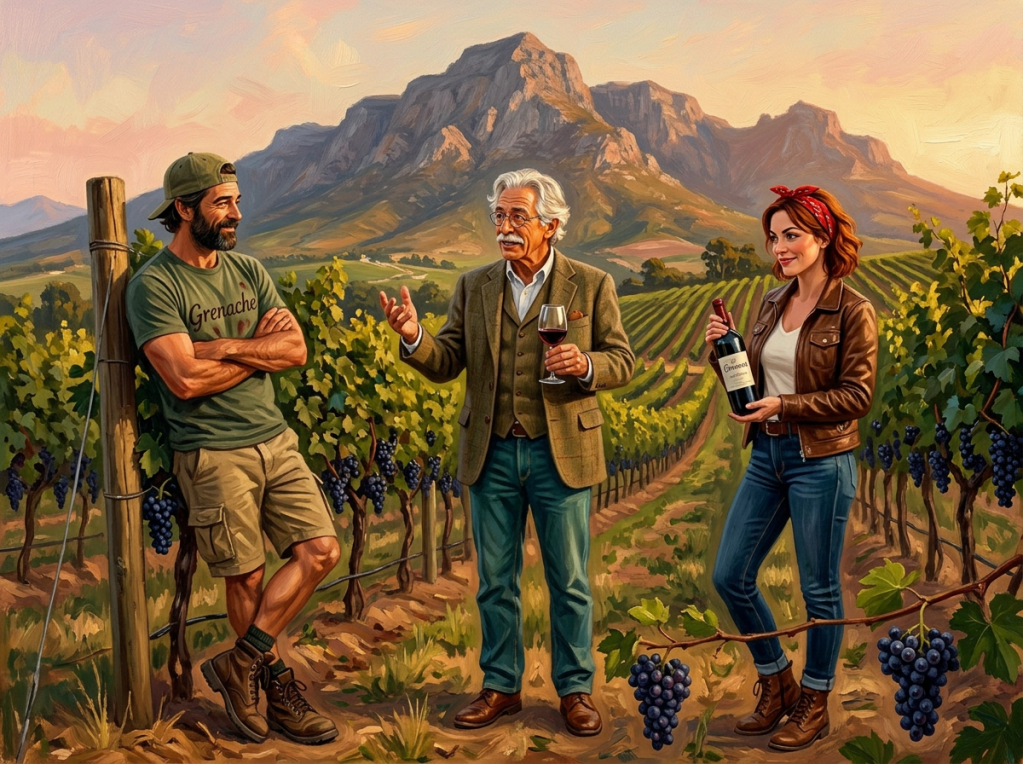
Professor Octavius Pinot stands amongst the vines with a glass of red in hand and the particular satisfaction of a man about to correct a historical oversight, Koos leaning against a vineyard post and Isabella waiting, bottle in hand, for him to get to the point.
“Do you realise,” he says, “that in a year of writing this blog, we have discussed Bordeaux blends, we have discussed Rhône blends, we have even discussed Grenache in two colours — and not once have we properly introduced the grape that makes most of it possible?”
Koos Grenache looks up from his glass, mildly offended on the grape’s behalf.
“Cabernet Sauvignon,” Octavius continues. “Arguably the most important red grape on the planet. And we’ve been talking around it for a year.”
Isabella Rioja raises an eyebrow. “That’s a little like writing a biography of a family and forgetting to mention the father.”
“Worse,” Octavius says. “It’s like writing about the father and never once letting him speak for himself — because everyone else in Bordeaux has been putting words in his mouth for three hundred years.”
Koos grins. “So today he gets the microphone.”
“Today,” Octavius agrees, “he gets the microphone. Let’s see what he says.”
An Accident Nobody Planned
Here is the first surprise, and it is a genuinely good one: Cabernet Sauvignon is not an ancient noble grape at all. It is, genetically speaking, a bit of an accident.
In 1996, University of California, Davis geneticist Carole Meredith and her doctoral student John Bowers used DNA profiling to settle a question wine people had argued about for years — where, exactly, did Cabernet Sauvignon come from? Their answer, published in Nature Genetics in 1997, surprised almost everyone. Cabernet Sauvignon is the natural offspring of two parents growing in neighbouring rows somewhere in Bordeaux, sometime before the 17th century: Cabernet Franc and Sauvignon Blanc.
“A red grape and a white grape,” Isabella says, “had a baby. And nobody wrote it down.”
“Nobody needed to,” Octavius says. “There was no reason to plant them side by side deliberately — no winemaker in the 1600s was trying to breed a new variety. Bees and wind did the work. A vine grew from a seed that fell where it shouldn’t have. And three or four centuries later, it turns out to be one of the most important accidents in agricultural history.”
It explains a great deal, once you know it. That faint green, herbaceous, capsicum note young Cabernet Sauvignon can show — the one winemakers spend a lot of effort farming and ripening their way out of — is a distant echo of Sauvignon Blanc’s grassy DNA, still audible in the family voice generations later.
Koos considers his glass with new respect. “So somewhere under all that tannin and cassis, there’s a house white trying to get out.”
“Somewhere,” Octavius says, “in the deepest part of its genetic memory. Yes.”
Bordeaux’s Paradox: The King Who Isn’t Allowed to Rule Alone
And here is the second surprise, which is really the whole point of this article.
Cabernet Sauvignon is the grape most associated with Bordeaux’s greatest wines — the backbone of First Growths like Latour, Lafite and Mouton-Rothschild, the grape collectors chase and auction houses fight over. And yet, if you go looking for a bottle labelled simply “Cabernet Sauvignon” from Bordeaux, you will search for a very long time. It essentially doesn’t exist. In its own homeland, Cabernet Sauvignon almost never appears alone.
“This confuses people,” Octavius admits. “They assume the most famous Cabernet region in the world must be full of Cabernet wines. Instead, it is full of Cabernet-led blends. There’s a difference, and the difference is the whole story.”
The explanation lies in Bordeaux’s temperament, which is politely described as “maritime” and less politely described as “unreliable.” Cabernet Sauvignon is a late ripener with thick, tannic skins — it wants warmth, and it wants time, both of which Bordeaux offers generously in some vintages and stingily in others. Left entirely to its own devices in a cool, wet year, Cabernet can finish a vintage green, hard and underripe.
So Bordeaux’s winemakers, centuries ago, did the sensible thing: they hedged. Merlot ripens earlier and fills out the mid-palate with softness and flesh. Cabernet Franc splits the difference — earlier than Cabernet Sauvignon, later than Merlot, adding perfume and lift. Together, the three form an insurance policy written in grapevines: whatever the weather does, something in the blend will perform.
This is also why Bordeaux is really two regions wearing one name. On the Left Bank of the Gironde estuary — Pauillac, Margaux, Saint-Julien, Saint-Estèphe — deep gravel soils drain fast and store the day’s heat, exactly what late-ripening Cabernet Sauvignon needs to reach full maturity. Cabernet dominates the blends here. Cross the water to the Right Bank — Pomerol, Saint-Émilion — and the soils turn to clay and limestone, cooler and wetter, better suited to Merlot, which duly takes the lead there instead.
“Same grape family,” Isabella says, “different sides of the same river, completely different order of seniority. Bordeaux didn’t choose a favourite child. It let the soil decide.”
Koos leans back. “So even in its home country, Cabernet’s never allowed to go solo. It’s always got a chaperone.”
“A very expensive chaperone,” Octavius adds dryly, “given what a bottle of Mouton costs.”
Breaking Free in the New World
If Bordeaux is the story of a grape kept carefully in check, California is the story of what happens when nobody tells it to behave.
Riper, more reliable sunshine meant Cabernet Sauvignon in Napa Valley could ripen fully most years without a supporting cast. Winemakers there began doing something almost unthinkable by Bordeaux standards: bottling it alone, and putting its name proudly on the label.
Then came the afternoon that changed everything.
On 24 May 1976, British wine merchant Steven Spurrier organised a blind tasting in Paris, pitting top California wines against France’s finest — Bordeaux reds against Napa Cabernets, white Burgundy against California Chardonnay. Nine French judges, all serious professionals, tasted blind. When the scores were tallied, Stag’s Leap Wine Cellars’ 1973 S.L.V. Cabernet Sauvignon had beaten Château Mouton-Rothschild and Château Haut-Brion outright.
“The room did not take it well,” Octavius says, with the air of a man still slightly wounded on behalf of his countrymen forty-nine years later.
The “Judgment of Paris” became one of the most consequential blind tastings in wine history. Overnight, it gave the New World permission to believe that Cabernet Sauvignon didn’t need a French postcode — or a supporting cast of Merlot and Cabernet Franc — to be world-class. Napa’s cult Cabernet culture, from Opus One (a joint venture between Robert Mondavi and Bordeaux’s own Baron Philippe de Rothschild, launched in 1979 — proof that even the French eventually joined in) to today’s five-figure “unicorn” bottlings, traces its confidence back to that one Parisian afternoon.
Australia had a similarly quiet, almost accidental beginning. In the mid-1960s, agricultural scientist Dr John Gladstones studied the climate of Western Australia’s remote south-west and concluded, purely from data, that the Margaret River area shared striking similarities with Bordeaux and ought to grow superb wine. Nobody had planted a commercial vineyard there yet. Two doctors, Tom Cullity and Bill Pannell, took the theory seriously enough to plant Cabernet Sauvignon and Malbec at what became Vasse Felix in 1967, followed by Moss Wood and Cullen soon after. By the 1980s, Cape Mentelle’s back-to-back trophy wins had put the region firmly on the map.
“A wine region,” Isabella says, “designed on paper before a single vine went in the ground. That’s either supreme confidence or a very expensive hunch.”
“In this case,” Octavius says, “it happened to be both.”
Isabella’s Spain: The Country That Got There First — Then Changed Its Mind
Isabella refills her glass and leans forward, clearly enjoying herself.
“Everybody tells the Napa story like Cabernet’s great rebellion against France happened in 1976,” she says. “It didn’t. It happened in Spain, over a century earlier — and almost nobody talks about it.”
In 1864, a Spanish landowner named Eloy Lecanda y Chaves returned home to Castile from Bordeaux, where he had studied winemaking, and did something quietly radical: he planted Bordeaux varieties — Cabernet Sauvignon, Merlot and Malbec — alongside Spain’s native Tempranillo on his estate on the Duero river. The estate became Vega Sicilia, and it has never stopped. Today, Vega Sicilia’s legendary Unico — one of Spain’s most sought-after and long-lived wines — is typically around eighty percent Tempranillo, with Cabernet Sauvignon providing structure and staying power in the remainder. Some vintages aren’t released for a decade or more.
“While the rest of the world was still arguing about whether Cabernet belonged outside Bordeaux,” Isabella says, “Vega Sicilia had already answered the question. They just didn’t feel the need to tell anyone.”
A century later, Catalonia had its own quiet revolution. In the mid-1970s, Miguel Torres — of the famous Torres wine family in Penedès — planted Cabernet Sauvignon and released it as Mas La Plana, a bold, single-vineyard statement in a region that had never really bottled the grape alone before. In 1979, at the Gault-Millau Wine Olympics in Paris, Mas La Plana’s 1970 vintage beat a flight of top Bordeaux reds in a blind tasting — a Spanish echo of the Judgment of Paris, arriving just three years later and considerably less discussed outside Spain than it deserves to be.
“So,” Koos says, counting on his fingers, “Spain does it in 1864. France gets upset about California in 1976. Catalonia quietly beats Bordeaux again in 1979. And somehow the history books only remember the middle one.”
“History,” Isabella says, “is written by whoever has the better publicist.”
And then there is Rioja — Isabella’s own namesake region — which makes the story even more interesting, because Rioja resisted Cabernet Sauvignon for a remarkably long time. Rioja’s wines have always been built around Tempranillo, and the region’s regulatory body was famously protective of that identity. Cabernet Sauvignon wasn’t formally authorised as a permitted variety under Rioja’s rules until 2007 — more than a century after Vega Sicilia had proven, just down the road in Ribera del Duero, exactly what the grape could do in Spanish soil.
“My own region,” Isabella says, shaking her head with real affection, “took longer to let Cabernet in the door than Australia did. We are many wonderful things in Rioja. Quick to embrace outsiders is not always one of them.”
“And yet,” Octavius points out, “when Rioja finally did let it in, most producers used it exactly the way Bordeaux does — as a supporting player alongside Tempranillo, not a replacement for it. Old habits, it seems, cross borders more easily than grapevines do.”
Koos’s Stellenbosch: The Grape That Became the Backbone
Koos sets down his glass with the particular reverence he reserves for home soil.
“Right,” he says. “My turn. And I’m not going to pretend this is an ancient Cape story, because it isn’t. Cabernet’s a twentieth-century arrival here — a relative newcomer, by our standards.”
The first vines Jan van Riebeeck planted at the Cape in the 1650s weren’t Cabernet Sauvignon at all — that’s a different, much older chapter of South African wine history. Cabernet’s real Cape story begins properly in the early 1900s, and one of its first notable chapters was written at Alto Estate on the slopes above Stellenbosch. Founded in 1919, Alto released its first vintage of Alto Rouge in 1922 — a blend built around Cabernet Sauvignon, with Shiraz and Cinsaut in support. It won top honours at the Cape Wine Show in 1924, the same year it began exporting to London, and remains one of South Africa’s oldest continuously produced premium red wine brands.
“Notice something familiar?” Koos says. “Even here, first time out the gate, Cabernet needed backup dancers. Bordeaux’s habits crossed the equator along with the cuttings.”
For much of the mid-twentieth century, though, Cabernet Sauvignon’s Cape ambitions were quietly throttled — not by the grape, but by circumstance. The KWV cooperative system prioritised volume and brandy production over fine varietal wine, and apartheid-era trade boycotts kept South African wine largely isolated from the international stage where a grape like Cabernet needed to prove itself.
Everything changed after 1994. With the country’s return to world markets came a wave of new investment, “flying winemakers,” and — crucially — a sharpened focus on the varieties the world already respected. Cabernet Sauvignon answered the call emphatically. By the late 2000s it had become South Africa’s single most widely planted red grape variety, the backbone against which the country’s fine wine reputation is still measured today.
Stellenbosch, in particular, turned out to have exactly the geology Cabernet likes to argue with. The decomposed granite soils on the slopes of the Simonsberg, Helderberg and Stellenbosch Mountain drain well and warm quickly — not Bordeaux’s gravel, but playing a strikingly similar role in the vine’s life.
Producers built entire reputations on it. Kanonkop’s single-varietal Cabernet Sauvignon has been one of the country’s most consistently awarded reds since the 1970s, while its Bordeaux-style blend, Paul Sauer — Cabernet-led, with Merlot and Cabernet Franc in support — proves that even Stellenbosch’s most committed Cabernet estate still reaches for a supporting cast when it wants to make its most serious statement.
Meerlust, further along the Helderberg, tells the same story in miniature — and in the correct order, which makes it rather a neat one. The very first wine ever to carry the Meerlust label, released in 1975, was a Cabernet Sauvignon. But it was never planted to stand alone forever: the long-term intention from the start was to eventually produce a proper Bordeaux-style blend, once the rest of the cast had caught up in the vineyard. That blend, Rubicon, didn’t arrive until 1980. For five vintages, Meerlust’s Cabernet stood entirely on its own, waiting for company that hadn’t finished growing yet.
“Which tells you something rather pointed,” Octavius says. “Even six thousand miles and three hundred years from Bordeaux, the grape’s best producers keep arriving at the same conclusion the Médoc reached centuries ago.”
“Maybe,” Koos says, “some habits aren’t bad habits. Meerlust knew it wanted Rubicon before Rubicon existed — they just had to wait for the rest of the cast to turn up. Maybe that’s just good winemaking, and everyone eventually finds their way to the same answer.”
A World Tour in a Glass: What to Expect Where
Not sure what’s in front of you? Here’s the quick version, region by region.
Bordeaux (Left Bank) — blended, not solo; cassis, graphite, cedar; firm, structured tannins; built for the cellar, not tonight.
Napa Valley — usually varietal; ripe blackcurrant, dark chocolate, often generous new oak; polished, powerful, ready to impress early.
Margaret River — varietal or lightly blended; blackcurrant and bay leaf, a savoury, cool-climate edge; elegant rather than heavy-handed.
Stellenbosch — varietal or Bordeaux-style blend; dark berry fruit with a distinctive mineral, earthy backbone from the granite soils; increasingly confident and age-worthy.
Ribera del Duero / Penedès — usually a minority partner to Tempranillo, or a bold single-vineyard statement; dense, dark-fruited, built to last decades in the best examples.
“One grape,” Isabella says, “five completely different personalities, depending on who raised it.”
Can the Wine World Survive Without Cabernet?
Octavius considers the question with the seriousness it deserves.
“No,” he says simply. “Take Cabernet Sauvignon out of the picture and you don’t just lose a grape — you lose the backbone of Bordeaux’s greatest reds, the wine that gave Napa its confidence, the grape that convinced Western Australia to bet an entire industry on a climate report, and the variety that turned Stellenbosch into a serious red wine region. Remove one accidental crossing from a seventeenth-century Bordeaux vineyard, and an enormous amount of what we think of as fine wine simply never happens.”
Isabella nods. “It is proof that greatness doesn’t need to be planned. It just needs the right neighbours.”
Koos raises his glass. “And it’s proof that even the most famous grape on the planet still needed help to get there. Cabernet’s the king, sure. But even kings need a decent cabinet.”
“Which,” Octavius says, allowing himself the smallest smile, “is rather the point we’ve been making all along.”
The Uncorked & Curious Takeaway
Cabernet Sauvignon is not an ancient noble grape with a plotted destiny — it’s a genetic accident from four hundred years ago that turned out to be one of agriculture’s luckiest mistakes. In Bordeaux, it rules but almost never rules alone. In Napa and Margaret River, it learned to stand on its own. In Spain, it arrived earlier than anyone gives it credit for, and was kept waiting at the door by the one region that shares Isabella’s name. And in Stellenbosch, in barely a century, it became the backbone of a country’s fine wine reputation.
Isabella Rioja “Some grapes travel well. This one travelled everywhere.”
Professor Octavius Pinot “And wherever it went, it changed the conversation.”
Koos Grenache “Next time someone hands you a glass of Cabernet, you’ll know it’s not just a wine. It’s an argument that’s been going on for three hundred years — and everyone involved still thinks they’re winning.”
At Uncorked & Curious, we believe great wine doesn’t have to be complicated — but it’s always more interesting with a story. Raise a glass. Stay curious.


Leave a Reply