
Koos Grenache is making his way round the table with a bottle, topping up glasses whether anyone’s asked him to or not.
He’s traded his usual shorts and Grenache T-shirt for jeans and a crisp blue button-down — the closest thing to “smart” Koos owns — and he’s rather pleased with himself about it. The three of them are at a café table in a Saint-Émilion square, string lights overhead, the old clock tower keeping time above the rooftops.
Koos: “Right. Everybody’s had their Cabernet Sauvignon lecture, everybody’s had their Pinot Noir existential crisis. Tonight we’re talking about the grape that actually gets invited to dinner parties.”
Isabella: “Merlot. Finally. The grape that does the work while Cabernet gets the credit.”
Octavius: “A slightly reductive summary, but not an unfair one.”
The Little Blackbird
“Merlot” comes from the old French merle, meaning blackbird — either because the grape’s blue-black skin reminded someone of a blackbird’s feathers, or because blackbirds have a habit of raiding the vines just before harvest and helping themselves to the ripest bunches. Nobody can agree which story is true, which is very on-brand for a grape that’s spent three centuries being both adored and taken for granted.
Merlot is one of the great Bordeaux varieties, first properly documented in the region in the late 1700s, though it was almost certainly being grown quietly for a good while before anyone bothered to write it down. Genetic testing has since confirmed what growers always suspected: Merlot is a natural cross of Cabernet Franc and an obscure variety called Magdeleine Noire des Charentes — which makes Merlot a half-sibling of Cabernet Sauvignon, not its understudy.
Octavius: “People assume Merlot is Cabernet’s softer cousin, bred to make Cabernet more approachable. It isn’t. They’re both children of Cabernet Franc, born on the same side of the family, just raised rather differently.”
Koos: “So Merlot’s not Cabernet’s little brother. It’s more like the sibling who moved to the coast and got better at people skills.”
A Family Tree, Not a Shadow
Once you know Merlot and Cabernet Sauvignon share a parent, the rest of the family starts making sense. Cabernet Franc is the quiet one — herbaceous, elegant, rarely the star but essential to nearly every great Bordeaux blend. Cross it with Sauvignon Blanc and you get Cabernet Sauvignon: structured, tannic, built to age. Cross it with Magdeleine Noire and you get Merlot: fleshier, earlier-ripening, more forgiving of a difficult vintage.
Merlot buds and ripens earlier than Cabernet Sauvignon, which made it the more reliable choice on Bordeaux’s cooler, damper Right Bank, while Cabernet Sauvignon thrived on the warmer, gravel-rich Left Bank. The split wasn’t about prestige to begin with — it was about which grape actually ripened where. The prestige came later, and mostly from marketing.
Why They Work So Well Together
Most classic Bordeaux is a blend, and Merlot is very often the largest single component even in wines that carry Cabernet’s reputation. The reason is practical rather than romantic: Cabernet Sauvignon brings structure, tannin and ageing potential, but on its own it can be austere, even a little gruff in its youth. Merlot brings mid-palate flesh, soft tannins and generous fruit that fills in the gaps.
Isabella: “It’s the reason a good Bordeaux blend tastes complete instead of just correct. Cabernet gives you the skeleton. Merlot gives you the muscle. Cabernet Franc gives you the perfume that makes you stop and pay attention.”
Koos: “So next time someone tells you they only drink Cabernet, ask them if they’ve checked the back label. There’s a good chance Merlot’s been doing half the work the whole time.”
The Right Bank Rebuttal
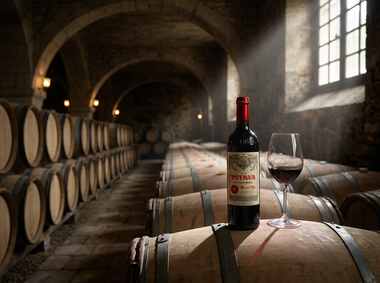
If Merlot ever needed to prove it could stand entirely on its own, it did so on Bordeaux’s Right Bank — specifically in the Libournais, the cluster of appellations built around the town of Libourne, taking in Pomerol and Saint-Émilion. Here, on clay and limestone rather than Left Bank gravel, Merlot isn’t the supporting player. It’s the headline act.
And nowhere makes that argument more emphatically than Pétrus. A tiny Pomerol estate, barely over eleven hectares, producing a wine that is almost entirely Merlot and routinely sells for the kind of money that makes First Growth Cabernet look like a bargain. There’s no grand château, no dramatic gates — just an unassuming pocket of clay-rich soil that happens to grow some of the most sought-after Merlot on earth.
Koos: [refilling glasses, entirely too pleased with the choice] “This is Pétrus. Mostly Merlot, all confidence. I thought, given the setting, we’d earned it.”
Octavius: [studying his glass rather than drinking it, for once] “Pétrus is the single best argument against ever calling Merlot a ‘softening agent.’ There is nothing soft about this. It is concentrated, structured and built to outlive most of us at this table.”
Isabella: “And it’s not alone. Château Le Pin, just down the road, is doing the same thing on an even smaller scale. Between them they’ve quietly made the case that Merlot, given the right soil and a lot less of it, can be the most collectible grape in Bordeaux.”
Velvet Glove, Iron Fist
Merlot’s reputation as “the easy grape” isn’t entirely wrong — it just isn’t the whole story. Young Merlot, made simply, is genuinely approachable: plush, plummy, low on aggressive tannin, easy to enjoy without much fuss. That’s exactly why it became the world’s introduction to red wine for an entire generation of drinkers.
But Merlot grown on the right site, farmed for lower yields and aged properly in oak — often French oak, sometimes a touch of new wood to firm things up — is a different animal entirely. Concentrated, structured, capable of ageing for decades. Pétrus proves the point; so does a well-made Right Bank Saint-Émilion from a serious vintage.
Octavius: “The mistake people make is judging the whole variety by its most commercial expression. That’s a bit like judging Pinot Noir by the cheapest bottle on a supermarket shelf.”
A Victim of Its Own Success
In the 1990s and early 2000s, Merlot became a victim of exactly the qualities that made it great. It was soft, fruity, easy to grow in a lot of places, and easy to sell. Producers planted it everywhere, often on sites that had no business growing anything so fine, and flooded the market with pleasant, forgettable, faintly interchangeable bottles. Then, in 2004, a film character memorably refused to drink “any [expletive] Merlot,” and the grape’s reputation took a very public hit it’s still recovering from in some markets.
Koos: “Funny thing is, that same year Pétrus was still selling for small fortunes to people who clearly hadn’t seen the film — or didn’t care.”
Isabella: “That’s the thing about Merlot’s bad reputation. It was never really about the grape. It was about what careless growers and lazy marketing did with it.”
Italy’s Second Identity
Merlot arrived in Tuscany in the 1970s and quietly helped start a small revolution. When a handful of ambitious producers began blending it, and Cabernet Sauvignon, with or instead of Sangiovese — outside the strict rules of Chianti Classico — they created what became known as the Super Tuscans: bold, internationally styled reds that didn’t qualify for any traditional appellation and didn’t much care.
The most extreme example is Masseto, from the same corner of coastal Tuscany as the famous Sassicaia estate, made entirely from Merlot on a patch of blue clay that producers there compare, not at all modestly, to Pomerol. It’s now considered one of Italy’s great wines — proof that Merlot’s Right Bank magic wasn’t just a Bordeaux accident of geology.
Koos’s Cape: The Grape We Don’t Take Seriously Enough
Koos: “Right, home turf. Merlot’s been in South Africa since the late 1800s, though for most of the 20th century it was mainly used to soften Cabernet blends, same as everywhere else. It’s only in the last couple of decades that we’ve started treating it as a serious wine in its own right — and honestly, we still don’t talk about it enough.”
South Africa’s best Merlot tends to come from cooler, well-drained sites where the grape can ripen slowly without turning jammy — parts of Stellenbosch, Elgin and the cooler pockets of the Western Cape in general. Done properly, it has real structure and ageing potential, not just the easy-drinking softness it’s often reduced to.
Worth trying:
- Meerlust Merlot (Stellenbosch) — one of the Cape’s benchmark examples, built for the cellar, not just the Tuesday table.
- Shannon Mount Bullet Merlot (Elgin) — cool-climate elegance, more perfume and restraint than power.
- Jordan Merlot (Stellenbosch) — polished, reliable, a good introduction to serious Cape Merlot.
- Vergelegen Reserve Merlot (Stellenbosch) — concentrated and age-worthy, from one of the estates that helped prove the Cape could do this properly.
- Almenkerk Merlot (Elgin) — small production, cool-climate precision, quietly one of the country’s best.
- Thelema Merlot (Stellenbosch) — mountain-vineyard freshness with real depth.
- Anthonij Rupert Merlot (Franschhoek) — structured and serious, made by people who clearly weren’t interested in Merlot’s easy-drinking reputation.
Where in the World Is Merlot?
Beyond Bordeaux, Tuscany and the Cape, Merlot has made itself comfortable almost everywhere red wine is grown. California’s Napa Valley produces both simple, everyday Merlot and serious, structured examples from top sites. Washington State has quietly become one of the grape’s most respected New World homes, with cool nights preserving the acidity that keeps the wines fresh. It’s a key part of Bordeaux-style blends in Australia’s Margaret River, does something bright and juicy in parts of Eastern Europe, and turns up as a reliable, food-friendly red almost everywhere in between.
Octavius: “It may be the most quietly successful grape on the planet. It doesn’t demand attention the way Cabernet or Pinot Noir does. It simply turns up, adapts to wherever it’s planted, and does its job rather well.”
And Then There’s Chile’s Case of Mistaken Identity
Isabella: “Now tell them the Chile story. It’s my favourite.”
Koos: “Right. So for the best part of a century, Chilean growers were absolutely convinced they were growing Merlot across huge stretches of vineyard. Made sense — the vines looked similar enough, the wine tasted broadly Merlot-ish, nobody had any reason to question it.”
Octavius: “Then, in 1994, a French ampelographer named Jean-Michel Boursiquot visited Chile and noticed something odd. Some of the ‘Merlot’ vines ripened later than they should, and the leaves weren’t quite right. DNA testing eventually confirmed it: a significant portion of what Chile had been calling Merlot for decades was in fact Carménère — a once-important Bordeaux variety that had all but vanished from France after phylloxera devastated European vineyards in the late 1800s.”
Isabella: “Everyone assumed Carménère was extinct. It wasn’t extinct — it had just emigrated. It had been hiding in plain sight in Chile the entire time, quietly pretending to be its more famous relative.”
Koos: “Chile’s response was rather brilliant, actually. Instead of being embarrassed about it, they leaned in. Carménère is now bottled and marketed proudly as Chile’s own signature grape — the country basically inherited a rare, nearly lost variety and turned it into a national identity.”
Octavius: “Which does mean, somewhat awkwardly, that a fair amount of wine sold internationally as Chilean Merlot before the mid-1990s wasn’t Merlot at all. A rare case of an entire country accidentally rebranding a grape by mistake — and coming out ahead for it.”
Can the Wine World Survive Without Merlot?
Take Merlot out of the picture and Bordeaux loses more than half its vineyard area and most of its most collectible wines, Pétrus and Le Pin included. Tuscany loses one of the grapes behind its most ambitious modern reds. Entire New World regions lose their easiest, most food-friendly introduction to serious red wine. And a great many drinkers lose the wine that first convinced them red wine didn’t have to be intimidating.
Isabella: “Cabernet gets the reputation. Pinot Noir gets the romance. Merlot just quietly makes sure the wine world actually works — in the blend, on its own, wherever it’s needed.”
The Uncorked & Curious Takeaway
Koos Grenache
“Don’t let anyone tell you Merlot is the safe choice. Pour the right bottle and it’ll out-argue the Cabernet every time.”
Professor Octavius Pinot
“Merlot is not Cabernet Sauvignon’s softer shadow. It is its equal, born of the same parent, and in Pomerol, arguably its better.”
Isabella Rioja
“The grape that does the work while everyone else takes the credit — and, every so often in a Pomerol cellar, finally gets to take a bow of its own.”


Leave a Reply