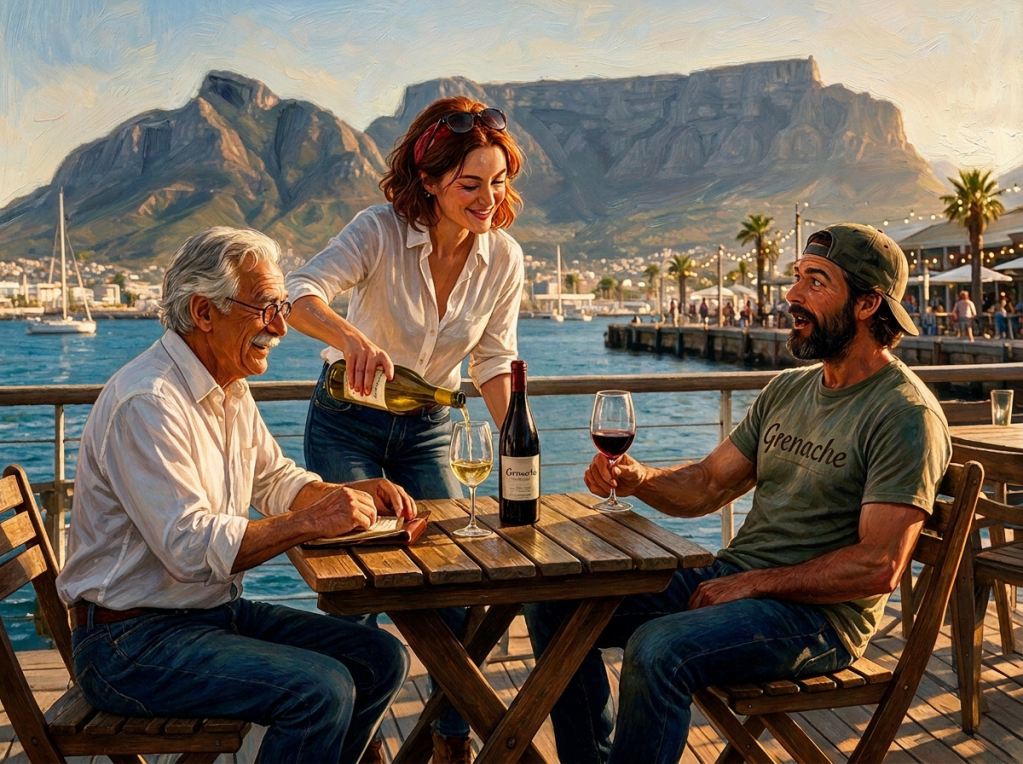
Isabella Rioja arrives late, sunglasses pushed up into her hair, and sets two bottles on the tasting table — one deep garnet, one pale gold.
“Sit down, gentlemen,” she says. “Today we’re talking about my side of the family.”
Koos Grenache raises an eyebrow. “Your side of the family? It’s literally got my name on the label.”
“Exactly,” Isabella says, pouring. “Which is why I get to do the talking. Grenache Blanc is a Spanish grape wearing a French passport, and nobody explains that better than someone who’s genuinely fluent in both.”
Professor Octavius Pinot settles into his chair, already reaching for his notebook. “Then let’s begin at the beginning. Because the beginning, in this case, is rather further back than most people assume.”
The Grape That Started in Spain, Not France
Here’s the thing that trips people up immediately: despite the very French-sounding name, Grenache did not start life in France at all.
“It’s Spanish,” Isabella says, with the quiet satisfaction of someone who has been waiting all day to say this. “Garnacha. Born in Aragón, in the north-east of Spain, sometime in the medieval period — nobody can agree on the exact century, but everyone agrees on the region.”
Ampelographers — the grape detectives of the wine world — trace it back to the old Kingdom of Aragón, a stretch of arid, sun-blasted terrain around Campo de Borja, Calatayud and Cariñena. It’s tough country, and Garnacha is a tough grape: thin-skinned but heat-loving, drought-resistant, and perfectly happy in poor, stony soils where fussier varieties would simply give up.
“There’s actually a rival theory,” Octavius adds, unable to help himself. “Some ampelographers argue for Sardinia instead, where the grape is known as Cannonau. The two theories aren’t mutually exclusive, mind you — Aragón ruled Sardinia for several centuries in the late Middle Ages, which is more than enough time for a favourite vine to hitch a ride across the Mediterranean in someone’s saddlebag.”
Koos shrugs. “Either way — it’s not French. Somebody tell the French.”
“They know,” Isabella says. “They just don’t bring it up.”
How a Spanish Grape Became the King of the Rhône
From Aragón, Garnacha spread the way tough, reliable grapes always do — quietly, steadily, and without much fanfare, following trade routes and royal marriages across the Pyrenees and into southern France.
By the time it arrived in the southern Rhône, it had a new name — Grenache — and a new job: becoming the backbone of one of the most famous red wines in the world.
“Châteauneuf-du-Pape,” Octavius says, with the reverence he usually reserves for very old Burgundy. “Grenache typically makes up sixty to eighty percent of the blend there. It’s sometimes called the King of the Rhône, and not without reason — it brings warmth, ripe red fruit and generous alcohol, while Syrah and Mourvèdre fill in the structure and spice around it.”
“The GSM blend,” Isabella says. “Grenache-Syrah–Mourvèdre. If you’ve ever had a big, warm, generous red from the southern Rhône or a good Australian equivalent, chances are Grenache was doing most of the heavy lifting.”
Koos leans forward. “Now here’s my favourite fact about that place. Tell them about the flying saucers.”
Octavius sighs, but tells them anyway. “In 1954, amid a nationwide UFO panic in France, the mayor of Châteauneuf-du-Pape passed an actual municipal decree banning flying saucers — and, specifically, ‘flying cigars’ — from flying over, landing, or taking off in the commune. Any that did would be impounded.”
“Impounded,” Koos repeats, delighted. “You just imagine the paperwork. ‘Reason for detention: extraterrestrial, unlicensed, possibly drunk on our Grenache.’”
“The decree is still technically on the books,” Octavius admits. “It was, by most honest accounts, a rather effective piece of publicity for the village.”
“So the most famous Grenache village on earth,” Isabella says, “built part of its fame on a law about spaceships. You cannot make this grape boring if you tried.”
Meet the Twin: Grenache Blanc
And now, Isabella says, we get to the part of the story that nobody tells properly.
“Everyone assumes Grenache Blanc is some unrelated white grape that just happens to share a name,” she says. “It isn’t. It’s not a cousin. It’s not a friend of the family. It is, genetically, the same grape as Koos.”
Koos blinks. “Come again?”
“Grenache Blanc,” Isabella says, “is a colour mutation of Grenache Noir. Same DNA. At some point, in a vineyard somewhere in Catalonia — most likely around Barcelona and Tarragona — a vine of ordinary red Grenache threw a genetic curveball and started producing pale, greenish-gold berries instead of dark ones. Everything else about the vine stayed the same. Same leaf shape, same cluster structure, same restless energy. Just — no colour in the skin.”
“So he’s got a twin,” Koos says slowly, looking at the pale gold glass in front of him. “An albino twin.”
“A blanc twin,” Isabella corrects. “And a third sibling too, while we’re at it — Grenache Gris, a grey-pink mutation that’s rarer and mostly overlooked, a bit like the middle child nobody writes songs about.”
Octavius, delighted by the ampelography of it all, can’t resist adding detail. “It’s the same phenomenon we see in Pinot Noir, Pinot Gris and Pinot Blanc — a single ancestral vine, splitting into colour variants over centuries of cultivation. Nature apparently gets bored and starts experimenting.”
“Which means,” Isabella says, raising the pale gold glass, “every time you drink Grenache Blanc, you are quite literally drinking Koos’s brother from another mother. Well — the same mother. Just a different outfit.”
Koos studies his own glass, then hers, with newfound respect. “Family reunion, then.”
“Family reunion,” Isabella agrees.
Grenache Blanc’s Own Rise to Fame
For centuries, Grenache Blanc did what most siblings of famous people do — it worked quietly in the background. In the southern Rhône, it was a blending grape, adding body and weight to white Châteauneuf-du-Pape and Côtes du Rhône blends without ever getting its name on the label.
“It brought richness and volume,” Isabella says. “Texture, essentially. It was the grape other grapes leaned on.”
But — much like her own Semillon story, she notes with a raised eyebrow at Octavius — Grenache Blanc eventually stepped out of the blend and into the spotlight. Producers in the Rhône and in Spain’s Terra Alta region in Catalonia began bottling it solo, showing off what it could do without three or four other grapes propping it up: waxy texture, stone fruit, green apple, a bright mineral or saline finish, and — because it’s genetically identical to a red grape underneath the skin colour — often surprisingly high alcohol.
“It’s a full-bodied white with a red wine’s constitution,” Octavius says. “Which explains a great deal, really.”
“Runs in the family,” Koos says.
And Then Came South Africa
Here the story turns local — and this is where Koos, predictably, has been waiting to jump back in.
Grenache Noir found its way to South Africa’s old bush vine vineyards generations ago, and today it’s become one of the country’s most talked-about categories, particularly for its climate resilience. In the hot, dry conditions of the Western Cape, it thrives where thirstier varieties struggle.
“The Swartland and Piekenierskloof are ground zero,” Koos says, with the pride of a man discussing his own back yard. “Old bush vines, granite and sandstone soils, proper heat. You get these pale, perfumed, peppery reds with crunchy red fruit and low tannins — the kind of thing you can serve slightly chilled and nobody looks at you strangely.”
Stellenbosch does a more structured, medium-bodied version with red berry and spice, while cooler pockets like Elgin and Bot River are turning out lighter, more perfumed, high-acid styles that would make a Rhône producer nod approvingly.
“And it’s not just red,” Isabella reminds him. “Don’t forget my side.”
Grenache Blanc arrived in South Africa rather more recently than its red sibling — first planted commercially in 1979 — and for a long time sat quietly in the background exactly as it had in the Rhône. That’s changed fast. Forward-thinking winemakers in warm, dry pockets of the Swartland and Paarl have taken it from blending component to genuine single-varietal star, and the results are winning serious attention from critics like Platter’s Wine Guide and Tim Atkin — full-bodied, richly textured whites with stone fruit, green apple and a clean mineral or saline finish.
“And then there’s the rest of the family showing up too,” Koos adds. “Grenache Gris making skin-contact orange wines and proper rosé. The whole clan’s turned up in the Cape at this point.”
Octavius nods approvingly. “It’s rather a neat illustration of the South African wine story more broadly — old European varieties finding new expression, and occasionally new fame, on unfamiliar soil.”
“It’s not new fame,” Koos says. “It’s overdue fame.”
Bringing It to the Table
Isabella tops up the glasses. “So — what do we actually do with it?”
Grenache Noir’s natural partner, everyone agrees without much debate, is fire. Its white pepper spice and bright raspberry fruit stand up beautifully to a proper wood-fired braai — lamb chops, boerewors, marinated pork belly — and its soft tannins mean it won’t fight with the gentle heat of a bobotie or a fruity lamb curry. Lighter styles are equally at home with charcuterie, duck breast and cherry sauce, or ostrich carpaccio.
Grenache Blanc, meanwhile, earns its keep with richer, more textural food — grilled prawns, seared scallops, Cape Malay chicken curry, roast chicken with lemon and thyme, or a wedge of creamy brie. Its natural affinity for cumin, coriander and stone fruit makes it a quietly brilliant match for the spice cupboard too.
“One family,” Isabella says. “Two very different dinner invitations.”
A Few Bottles Worth Chasing Down
“If people are going to go looking,” Koos says, “they should know where to start.”
On the Grenache Noir side:
- Soldaat by The Sadie Family (Piekenierskloof) — pale, perfumed, old bush-vine Grenache with white pepper and crunchy strawberry fruit. About as classic as South African Grenache Noir gets.
- Momento Grenache by Marelise Niemann (Swartland/Bot River) — elegant, fruit-forward, and a good introduction to the lighter, more perfumed style Koos keeps banging on about.
On the Grenache Blanc side:
- KWV The Mentors Grenache Blanc (Paarl) — a benchmark bottling that regularly pulls 95+ scores at international wine challenges. Elegant and precise.
- The Foundry Grenache Blanc — classic Rhône-style texture and depth, with the bright acidity to keep it honest.
- Scions of Sinai ‘Gramadoelas’ Grenache Blanc — sourced from unique terroir and a regular top-tier scorer in Platter’s Guide.
And for the curious:
- FRAM Grenache Gris Skin Contact — Koos’s preferred form of mischief: a wacky, wild orange-style wine from the paler, pinker third sibling nobody talks about enough.
- Raats Family Grenache Rosé — clean, crisp, grapefruit-driven proof that this family does pink rather well too.
“That’s homework enough for one weekend,” Isabella says.
“Good homework,” Koos says.
The Uncorked & Curious Takeaway
Koos raises his glass — the dark one — and Isabella raises hers, pale gold in the last of the afternoon light.
“Same roots,” Koos says. “Same stubborn Spanish grandmother, whoever she was.”
“Different colour,” Isabella says. “Different mood. Different meal.”
Octavius closes his notebook. “And both, as it happens, currently having rather a good moment in South Africa.”
Koos grins. “Told you it wasn’t just Steen.”
Isabella
“Some grapes travel for centuries before anyone notices what they’ve become.”
Professor Octavius Pinot
“And some simply needed the right colour — and the right country — to finally be taken seriously.”
Koos Grenache
“And some of us just needed everyone to catch up.”


Leave a Reply