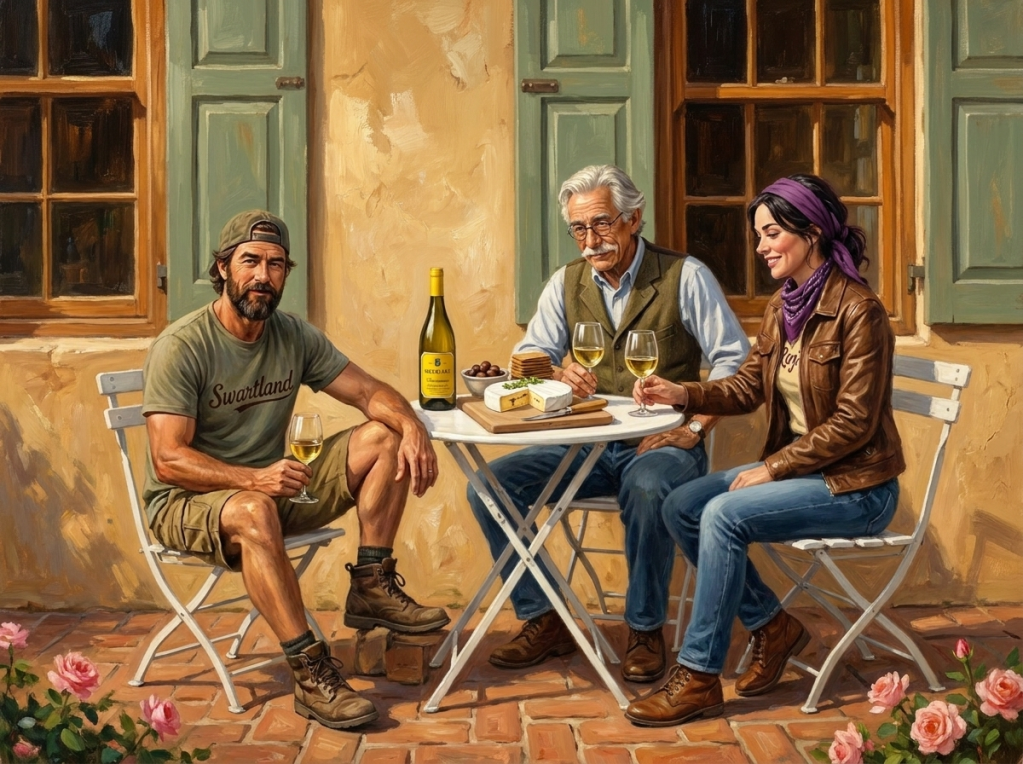
Koos sits back with his Chardonnay like a man who has been waiting for exactly this moment. Octavius studies the Dalewood Brie with the intensity he usually reserves for old Burgundy. Isabella smiles at something only she finds funny. On the table between them: a bottle of Meerlust, a board of magnificent cheese, and the comfortable silence of people who know how to eat and drink well.
There is a road in the Cape Winelands — the Klapmuts and Simondium road — that passes quietly through some of the most beautiful farming country in South Africa. Most people drive it on their way to Franschhoek, glancing at the mountains, perhaps slowing for a tractor. Few stop at the small sign that reads Dalewood Fromage.
They are missing something extraordinary.
Dalewood is not a deli. It is not a boutique food concept or a weekend market pop-up. It is a working farm — a proper, muddy-booted, Jersey-cow-and-early-mornings working farm — where the Visser family have been making cheese the way great wine estates make wine: from the ground up, with the soil and the animals and the seasons doing most of the talking.
And that, as it happens, is exactly the right place to start a conversation about cheese and wine.
Terroir: Not Just a Wine Word
Ask Octavius about terroir and settle in — you’ll be there a while. He’ll tell you about the specific interaction of soil, climate, aspect, and vine that gives a wine its sense of place. He’ll mention Burgundy. He’ll probably mention Burgundy twice.
But here is the thing Octavius knows and Koos will cheerfully point out: terroir is not a wine word. It is a food word. It belongs just as much to cheese, to olive oil, to bread, to anything that comes from a specific piece of land tended by people who care about what they are doing.
“The milk tells you where the cow has been,” says Koos, in a moment of unusual poetry. “A Jersey grazing on diverse Winelands pasture, no hormones, no unnecessary antibiotics — that milk tastes different. You can’t fake that in a vat.”
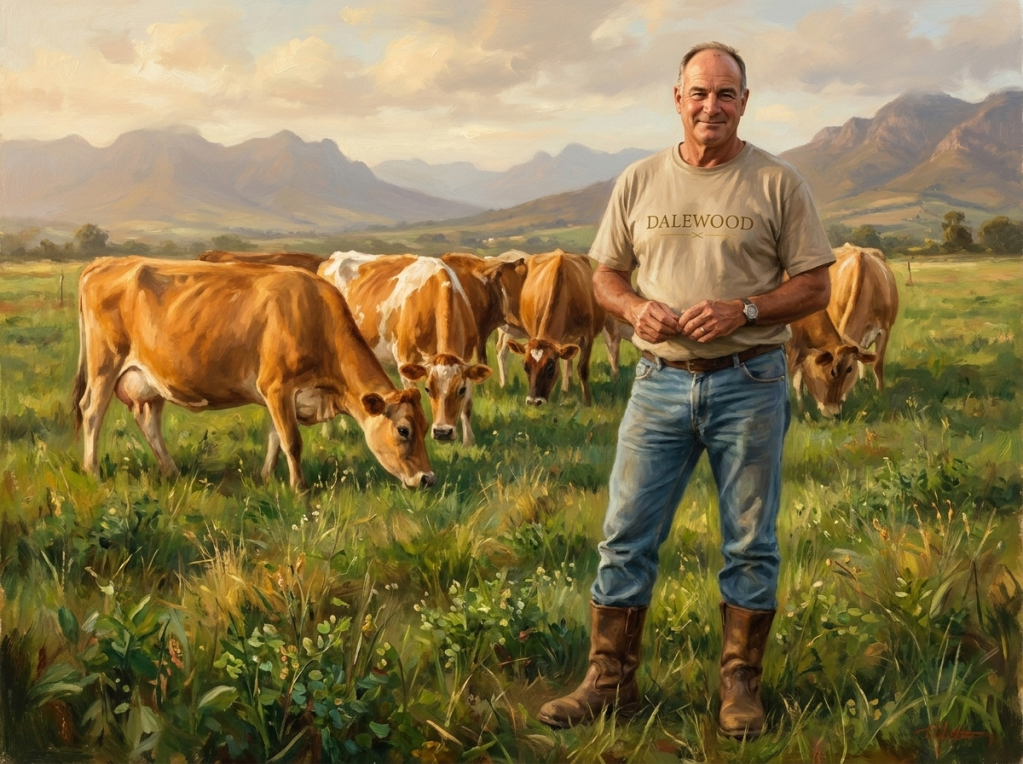
Rob Visser — cheesemaker, second-generation farmer, and a man who learned his craft the best possible way: by travelling to France, haunting traditional fromageries, and tasting everything he could get his hands on before coming home and applying all of it to milk from his own Jersey herd. The result is what Dalewood calls, with complete accuracy, an estate cheese — made entirely from their own milk, shaped by their own land, carrying the personality of a specific place.
The farm has been farmed regeneratively for twenty-five years — restoring natural soil balance, nurturing over fourteen species of grasses and legumes in the pastures, and producing milk without harmful chemicals, fertilisers or pesticides. The result is a more nutrient-dense product and a farm that contributes to a genuinely biodiverse agricultural system.
Sound familiar?
“It’s exactly the same philosophy,” says Isabella, who has been listening with the expression of someone who has been waiting to make this point. “A great wine estate controls everything from vine to bottle. Dalewood controls everything from pasture to platter. The obsession with provenance, with authenticity, with letting the place speak — it’s identical. Just one smells of fermentation and the other smells of rind.”
Octavius opens his mouth. Isabella pours him a glass. He closes it again.
Meet the Cheeses
Before we talk about what to drink, let’s talk about what’s on the board. Because Dalewood’s range is not a random collection of cheeses — it is a carefully considered family, each member with its own character, its own story, and its own demands when it comes to wine.
The Huguenot is the patriarch. Named in honour of the French Huguenot settlers who brought their winemaking and farming traditions to this very corner of the Cape in the seventeenth century, it is a semi-hard, brushed-rind cheese matured for at least six months — and in special editions, for a full year or more. The flavour is nutty, complex, and deeply satisfying, with the kind of depth that only time and good milk can produce. It has won Gold at the World Cheese Awards. It has won Super Gold at the World Cheese Awards. It has been South African Champion more times than Octavius has corrected someone’s pronunciation of Savennières. It is, in short, South Africa’s answer to Comté— but with its own unmistakable Cape personality.
The Boland is the Huguenot’s younger, more approachable sibling. Semi-hard, matured for around three to six months, with a milder, creamier character that makes it the most versatile cheese on the board. Think of it as the Chenin Blanc of the cheese world — unpretentious, food-friendly, wildly underrated, and capable of surprising you completely.
The Lanquedoc is where things get interesting. A semi-soft, washed-rind cheese made with wild cultures, it develops a subtly herbal, complex flavour that Koos describes as “the kind of cheese that asks questions.” The washed rind gives it an assertive, slightly pungent character on the outside, while the interior remains oozy and rich. It is not for the timid. It is absolutely for Isabella, who has already had a second piece.
The Brie Superlatif is exactly what it sounds like — a French-style Brie that takes the classic format and does it with the richness that only full-cream Jersey milk can provide. Creamy, buttery, with that characteristic white mould rind and a flavour that deepens beautifully as it comes to room temperature. Serve it properly — never straight from the fridge — and it will reward you generously.
The Camembert — including Dalewood’s remarkable Blue Camembert, which bridges the gap between the creamy white mould world and the bolder territory of blue cheese — is for those who want the softness of a Camembert with an unexpected twist. The blue veining is subtle, the flavour is gentle enough for blue-cheese newcomers, and it is the kind of thing that disappears from a cheese board before anyone admits to having eaten it.
The Pairings: What to Pour
Now. The reason you are all here.
Koos has opinions. Octavius has principles. Isabella has already started. Let’s talk about what actually works.
Huguenot — The Nutty Patriarch
A cheese this complex and this long-matured needs a wine with the structure and depth to keep up. The nuttiness of the Huguenot sings alongside an aged Chenin Blanc with some oak influence — the beeswax and honey notes in a well-made wooded Chenin mirror the cheese’s own complexity beautifully. A Cape Blend or a structured Cabernet Franc also works brilliantly — the subtle tannins cut through the richness of the cheese while the fruit character plays off the nuttiness.
For a more European angle, a glass of Chardonnay — particularly a Burgundian-style expression with good acidity and some toasty oak — is a classic match that Octavius will advocate for loudly and correctly.
The experience: Shave thin slices of Huguenot over a warm mushroom and thyme tart, or serve it alongside a quince paste and sourdough board with a glass of aged Chenin. This is not a quick snack. This is an occasion.
Boland — The Versatile Crowd-Pleaser
The Boland’s mild, creamy character makes it the most wine-friendly cheese on the board. Almost anything works — which is both its greatest virtue and the reason Octavius finds it slightly uninteresting. An unoaked or lightly oaked Chardonnay is a natural partner. A crisp Sauvignon Blanc from Elgin or the Constantia Valley cuts through the creaminess with bracing freshness. Even a lighter-style Pinot Noir — cool-climate, silky, not too tannic — pairs beautifully.
The experience: Imagine Forelle pears poached in white wine and spices until just yielding, laid over crisp curly kale and dressed with a Boland-laced pecan vinaigrette — finished with generous shavings of the cheese itself scattered over the top like edible confetti. It is the kind of salad that makes people ask for the recipe before they have finished the plate. Pour a glass of unoaked Chenin and eat it on the stoep. Repeat as necessary.
Lanquedoc — The Provocateur
This is where the fun starts and the rules bend. The Lanquedoc’s washed rind and herbal complexity demand a wine with enough personality to stand its ground. Roussanne or a Viognier — with their aromatic, floral, slightly exotic character — are wonderful partners. A Grenache Blanc or a full-bodied, textured white blend has the weight to match the cheese without being overwhelmed.
For reds, a Grenache-based Rhône-style blend — think Swartland, think Koos’s natural territory — works with quiet brilliance. The earthiness of the wine and the herbal, funky complexity of the rind speak the same language.
“This cheese and a good Grenache,” says Koos, with the satisfaction of a man who has done his research extensively and repeatedly, “is one of the great combinations. Don’t argue with me.”
Nobody does.
The experience: Serve Lanquedoc at room temperature on a wooden board with dried figs, honeycomb and walnuts. Or bake it — lightly wrapped in phyllo pastry with a drizzle of honey and a crack of black pepper — and serve it as a starter with a glass of Viognier. It will be talked about.
Brie Superlatif — The Elegant Classic
Brie and bubbles is one of the great truisms of the wine and cheese world, and it is a truism because it is true. A well-made Cap Classique — crisp, yeasty, with good acidity — cuts through the rich, buttery creaminess of the Brie and refreshes the palate beautifully. Octavius approves. Isabella insists on it.
For still wines, a delicate Chardonnay or an unoaked Chenin Blanc with bright acidity are both excellent choices. Avoid anything too tannic — big red wines bully Brie into submission and leave both parties looking bad.
The experience: Score a whole Dalewood Camembert with criss-cross slits, drizzle with olive oil and roast it until molten and trembling. While it bakes, caramelise Pink Lady apple slices in butter and muscovado sugar with fresh thyme until golden and syrupy. Spoon the apples over the oozing cheese, pierce the sides to let the molten centre escape, and serve with toasted baguette slices for piling high. This is what Sunday mornings were made for.
Blue Camembert — The Wildcard
Blue cheese and wine is traditionally the territory of the sweet and the fortified — and a Noble Late Harvest Chenin Blanc alongside the Blue Camembert is a combination that will stop conversation at the table. The sweetness of the wine, the honey and apricot notes, the viscous richness — all of it plays off the gentle blue tang of the cheese in a way that feels almost unfairly delicious.
For those who prefer a dry option, a Viognier or a full, ripe Chenin Blanc with some residual sweetness bridges the gap without going full dessert wine. Koos, predictably, suggests a skin-contact white — and Koos, predictably, is not wrong.
The experience: Score fresh figs deeply, wrap each one in a silk-thin slice of prosciutto, press a sliver of Dalewood Blue Brie into the cavity with a sprig of thyme, and roast until the cheese melts and the prosciutto crisps at the edges. Finish with a drizzle of balsamic glaze. It is simultaneously one of the simplest and most impressive things you can put in front of guests. Pour a glass of Noble Late Harvest. Eat slowly. Say nothing.
The Estate Principle: More Than Just a Meal
Here is the thought worth sitting with, somewhere between the second glass and the third piece of cheese: what makes this combination more than just good food and good wine is the shared philosophy behind both.
Dalewood Fromage and the great wine estates of the Cape are doing the same thing. They are taking a specific piece of South African land, tending it with care and integrity, and producing something that could not have come from anywhere else. No preservatives, no shortcuts, no compromise. Just the land, the animals, the vines, the seasons, and the people who understand them.
That is what terroir means. And that is what you taste when the Huguenot meets the Chenin Blanc, or the Lanquedoc meets the Grenache, or the Brie Superlatif meets the Cap Classique.
“This is why wine and cheese belong together,” says Octavius quietly, setting down his glass. “Not because some rule says so. Because they come from the same impulse — the human desire to take what the earth offers and make it into something worth sharing.”
Koos raises his glass.
Isabella cuts another piece of Lanquedoc.
Nobody argues.
Find Dalewood Fromage
Dalewood Fromage is on the Simondium – Klapmuts road, 20 minutes from Franschhoek. Make a point to visit them,The Cheesery Shop stocks their full range and a visit is an experience in itself. Selected cheeses are also available at Woolworths, Checkers, Spar, and Food Lovers Market across the Western Cape.
Visit www.dalewood.co.za for more.
At Uncorked & Curious, we believe the best moments happen when great wine meets great food — and great people. Raise a glass. Cut the cheese. Stay curious.


Leave a Reply