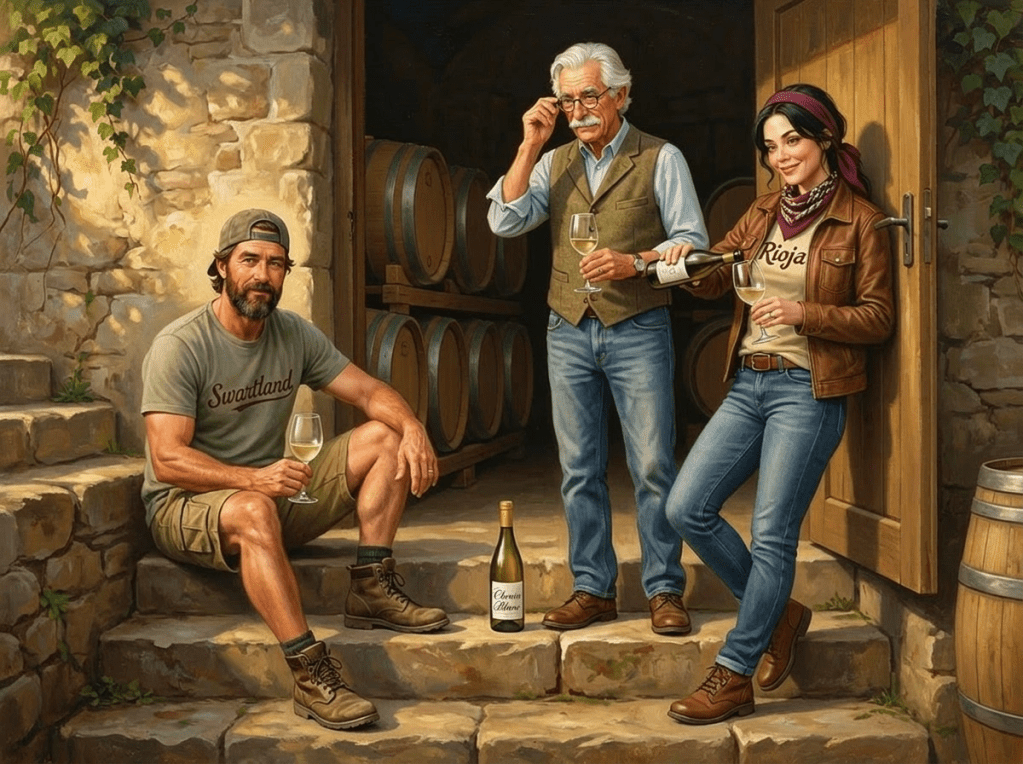
Koos plants his boots on the cellar steps. Octavius adjusts his reading glasses. Isabella refills her glass. And between them sits a bottle of Chenin Blanc — the grape that once filled boxes and fuelled braais, and now makes some of the most extraordinary wine on the planet. Funny how things turn out.
There is a grape growing in the Western Cape that has been here longer than most of us can remember, planted by farmers who called it Steen and used it to make everything from fizz to brandy to the kind of bulk white wine that came in boxes. For decades, nobody gave it much thought. It was the workhorse of the Cape — reliable, productive, unfussy. A bit like a good bakkie: everyone had one, nobody wrote poems about it.
And then, quietly, the world changed.
Today, that same grape — Chenin Blanc, to give it its Sunday name — is the subject of hushed reverence in wine circles from London to Tokyo. South Africa has more old-vine Chenin than France’s Loire Valley, where the grape originated. And what our winemakers are doing with those ancient, gnarled bushvines is nothing short of extraordinary.
Koos Grenache has been saying this for years, of course, usually to anyone who would listen over a braai fire in the Swartland.
“People used to look at me like I was mad,” he says, pouring a glass of something golden and alive. “Steen, they said. That’s just Steen. Like it was embarrassing. Meanwhile I’m standing in a vineyard of fifty-year-old bushvines thinking — this is it. This is the one.”
Octavius Pinot, predictably, has a more measured view.
“Credit where it’s due,” he says, peering at the glass with the intensity of a man who once spent three days reading a paper on malolactic fermentation. “The Loire Valley recognised Chenin’s greatness centuries ago. Vouvray, Savennières, Montlouis — these are benchmark expressions. South Africa is simply now catching up to what France always knew.”
Isabella Rioja raises an eyebrow from the corner.
“Catching up?” she says sweetly. “Darling, in some cases they’ve overtaken.”
The Identity Crisis Years
Let’s be honest about the history. For much of the twentieth century, Chenin Blanc was treated as a workhorse variety in South Africa. It was planted everywhere — not because winemakers were particularly passionate about it, but because it produced large crops reliably and could be used for almost anything: dry table wine, semi-sweet wine, sparkling wine, brandy, and grape juice. It was the Swiss Army knife of the Cape winelands, and it was about as glamorous as one.
While Sauvignon Blanc and Chardonnay were winning competitions and appearing on restaurant wine lists with fanfare, Chenin — still widely called Steen — sat in the corner, doing its job, unappreciated.
“It was a volume grape,” Koos admits. “And there’s no shame in that. But when everyone stopped caring, the old vines just kept growing. Forty years. Fifty years. Sixty years. Nobody pulled them out because they weren’t fashionable enough. And those vines — those old dryland bushvines — they were quietly becoming something extraordinary.”
What saved Chenin in South Africa wasn’t a marketing campaign. It was a handful of maverick winemakers who looked at those neglected old vines, tasted what they could produce, and thought — why is nobody talking about this?
The Revolutionaries
The story of South African Chenin’s renaissance is inseparable from a group of winemakers who were, frankly, a little obsessed.
Eben Sadie is one of the most influential winemakers — and has been quietly championing old-vine Chenin for decades. His approach is unflinching: minimal intervention, deep respect for old vines, wine that expresses a specific place rather than a winemaker’s ego. His Old Vine Series work with Chenin helped put the world on notice that the Cape was doing something remarkable.
Ken Forrester has become synonymous with Chenin Blanc in a way that few winemakers anywhere become synonymous with a single grape. His FMC (Forrester Meinert Chenin) — a collaboration with winemaking legend Martin Meinert — is one of South Africa’s most celebrated whites. Rich, complex, age-worthy, and utterly unique. The FMC is the kind of wine that makes Octavius go quiet and Koos top up everyone’s glass without saying a word.
“Ken understood before most people that Chenin wasn’t just a workhorse variety,” says Isabella. “It was a racehorse in a working saddle. You just had to take the saddle off.”
Adi Badenhorst of Badenhorst Family Wines in the Swartland brought his characteristic wildness to Chenin — ferments that feel alive, wines that don’t conform, and a philosophy that has inspired a generation of winemakers to think differently about what the Cape can do.
Alheit Vineyards — Chris and Suzaan Alheit — built an entire winery around old-vine Chenin and have been rewarded with some of the most breathlessly admired wines in South Africa. Their approach is almost archaeological: searching out the oldest, most remote vineyard sites and coaxing from them wines of extraordinary complexity and elegance.
Mullineaux — Chris and Andrea Mullineaux — produce Chenin that straddles the line between scientific precision and soulful expression. Their Kloof Street range makes world-class Chenin accessible; their single-vineyard expressions make it profound.
David & Nadia Sadie (no relation to Eben) have quietly become one of the most important voices in South African Chenin. Their single-vineyard Chenins are studies in terroir — how the same grape can taste completely different depending on which patch of ancient Swartland soil it grew in.
“What all these people have in common,” says Octavius thoughtfully, “is that they understood Chenin as a vehicle for place. Not a vehicle for technique. Not a variety to be polished into something internationally palatable. A mirror for South African soil.”
Koos nods. Which, from Koos, is high praise.
The Incredible Range of Styles
Part of what makes Chenin so endlessly fascinating is its flexibility. In South Africa alone, it produces wines of wildly different character — each one legitimate, each one delicious in its own context.
Bone-dry and unwooded — fresh, zippy, with vibrant acidity and flavours of green apple, quince, and citrus blossom. This is your everyday, everything-wine. Perfect with grilled fish, salads, snoek pâté on a Saturday morning, or simply on its own in the late afternoon sun on the stoep.
Wooded and complex — when Chenin is fermented or aged in oak (particularly older, neutral oak barrels), it takes on an altogether more serious character. Creamy textures, notes of beeswax, lanolin, stone fruit, and honey. The FMC lives here. So do the Alheit and Mullineaux expressions that wine lovers discuss in reverent tones.
Skin-contact or “orange” Chenin — Koos’s preferred form of mischief. When Chenin is left in contact with its grape skins during fermentation, the result is a wine of deeper colour, gripping texture, and wild, funky complexity. It is not for everyone. It is absolutely for Koos.
Sparkling — Chenin is one of the workhorses of South African Cap Classique, providing freshness and backbone to many of the country’s best bubbles.
Noble Late Harvest — and then there is this. When Chenin is affected by botrytis (noble rot, the same magical fungus responsible for Sauternes), it produces dessert wines of concentrated, honeyed, apricot-drenched brilliance. South Africa’s Noble Late Harvest Chenins are world-class, and remain one of the best-kept secrets of the Cape.
“The range is almost absurd,” says Isabella admiringly. “No other white grape does this. Sauvignon Blanc is Sauvignon Blanc wherever you find it. Riesling has range, yes — but Chenin? Chenin is a shapeshifter.”
The Loire Connection
For Octavius, no discussion of Chenin Blanc is complete without a respectful nod across the Atlantic to its homeland.
The Loire Valley in France has been making serious Chenin Blanc for centuries. Vouvray produces both dry and sweet expressions of extraordinary longevity — a great Vouvray can age for fifty years and emerge still vibrant. Savennières, from a tiny appellation near Angers, makes arguably the most austere and mineral dry Chenin on earth. Montlouis, Bonnezeaux, Quarts de Chaume — these names carry real weight in the wine world.
“The Loire showed us that Chenin Blanc is a noble variety,” says Octavius. “The problem was that South Africa spent decades growing it for the wrong reasons. Once winemakers started growing it for the right reasons — old vines, low yields, minimal intervention — the results were inevitable.”
Isabella, who has spent time in both the Loire and the Swartland, puts it simply: “They are cousins. Beautiful, complicated, occasionally infuriating cousins. But the South African version has something the Loire will never have — those ancient African soils, and the sunshine to ripen fully without losing freshness.”
The Value for Money Secret
Here is something Koos wants you to know, and he wants you to know it urgently: you do not have to spend a fortune to drink extraordinary Chenin Blanc.
While the benchmark bottles from the names above command serious prices — and are worth every cent — South Africa also produces a remarkable range of everyday Chenin at prices that make the Europeans weep with envy.
For under R150 a bottle, you can find Chenin Blancs that are genuinely world-class in their category: fresh, vibrant, food-friendly, endlessly drinkable. This is the grape that has fed the Cape for generations, and its democratic spirit has not entirely left it. At many estates and co-operatives, Chenin is still the wine that over-delivers extravagantly at accessible price points.
“This is what I love about it,” says Koos, with unusual tenderness. “You can drink a great Alheit and feel like you’re touching something profound. And you can pick up an everyday Chenin at your local bottle store and crack it open with cold leftover chicken and it is absolutely perfect. Not many grapes can say that.”
For summer drinking, Chenin is frankly hard to beat. Serve it well-chilled (around 8–10°C), and it works with almost everything the South African summer demands: seafood, light salads, spicy food (the natural sweetness in off-dry styles tames chilli beautifully), or simply on its own as the sun goes down and the braai takes care of itself.
The Old Vine Project
No story about South African Chenin is complete without mentioning the Old Vine Project — an initiative that has been quietly doing one of the most important jobs in the Cape wine industry: identifying, protecting, and celebrating vineyard sites over 35 years old.
South Africa is sitting on a treasure that the wine world is only beginning to understand. Old vines produce fewer grapes, but those grapes carry extraordinary concentration and complexity. They have deep root systems that draw on mineral-rich soil layers that younger vines cannot reach. The resulting wines have a texture and depth that cannot be manufactured.
The Old Vine Project’s Certified Heritage Vineyard seal on a bottle is your guarantee that the wine comes from these irreplaceable old vines — a guarantee that connects you, glass in hand, to decades of Cape wine history.
“If we lost those old Chenin vineyards,” says Octavius quietly, “we would lose something that could never be replaced. You cannot replant history.”
For once, nobody disagrees with him.
The Bottom Line
Chenin Blanc is South Africa’s grape. Not because we invented it — the Loire Valley can have that credit, and Octavius will never let us forget it — but because this country has done something extraordinary with it. We kept the old vines when others would have pulled them out. We found winemakers with the courage to let those vines speak. And we ended up with a grape variety that produces everything from summer-afternoon simplicity to age-worthy wines of global significance.
“It was never just a workhorse,” says Koos, pouring the last of the bottle. “We just forgot to look properly.”
Isabella raises her glass.
“To Steen,” she says.
“To Chenin,” says Octavius.
“To old vines,” says Koos.
They all drink. Outside, the Boland mountains catch the last of the afternoon light, and somewhere in the Swartland, a fifty-year-old bushvine does what it has always done — quietly, stubbornly, magnificently — and produces another small crop of extraordinary grapes.
At Uncorked & Curious, we believe great wine doesn’t have to be complicated — but it’s always more interesting with a story. Raise a glass. Stay curious.


Leave a Reply