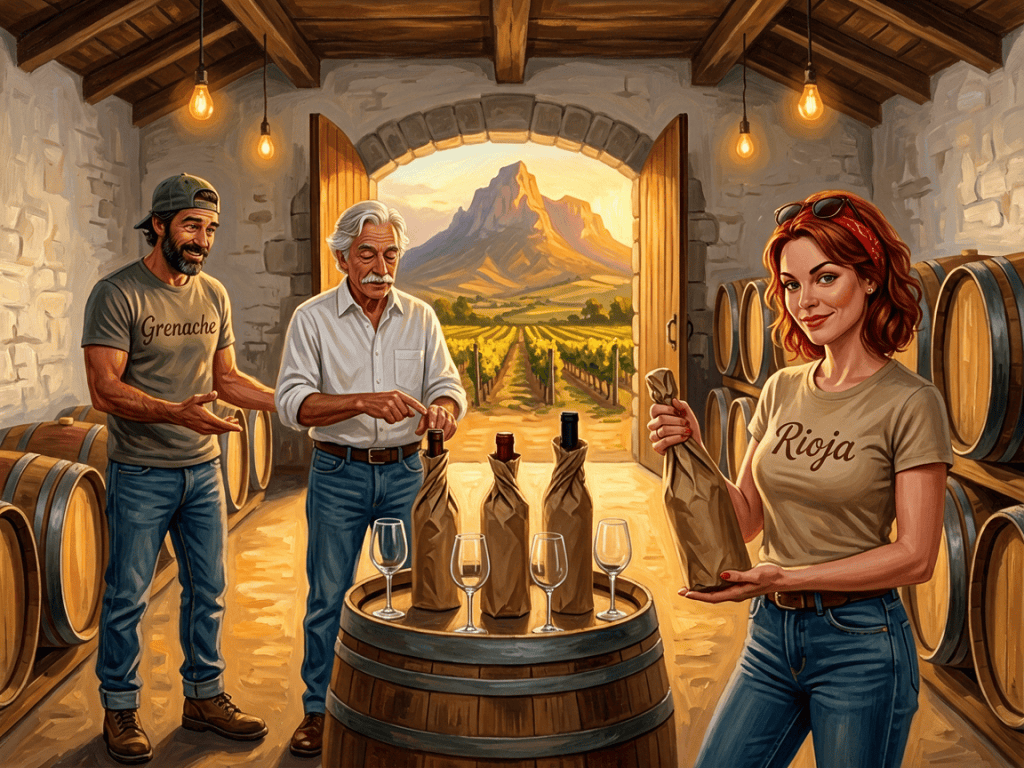
Three bottles stand on an upturned barrel in Koos Grenache’s cellar. Each one is hidden inside a brown paper bag, twisted tight at the neck. Isabella holds the fourth.
“Blind tasting,” Koos announces. “No labels. No clues. Pure skill.”
Professor Octavius Pinot doesn’t reach for a glass. He reaches for the first bag and runs his hand slowly down its side, the way a man might stroke a cat.
“Sloping shoulders,” he murmurs. “Wide base. Generous punt. Burgundy. Pinot Noir or Chardonnay — and judging by the weight, someone thinks rather highly of it.”
Koos stares at him.
“That’s cheating.”
“That,” says Octavius, “is observation.”
Isabella Rioja picks up the fourth bag, weighs it in her palm and laughs.
“And this one is heavy enough to stun a burglar. Bubbles, Koos. You’ve hidden a Cap Classique in a paper bag and hoped we wouldn’t notice.”
Koos sighs and pours. “Fine. Tonight we talk about bottles.”
Before Shapes, There Were Onions
For most of wine’s long history, the bottle wasn’t where wine lived. Wine travelled and aged in barrels. Bottles — when anyone could afford them — were for carrying wine from the barrel to the table.
“Early glass was fragile, expensive and frankly unreliable,” Octavius explains. “Wood-fired furnaces simply couldn’t produce glass strong enough for serious work.”
Then came an unlikely hero: the Royal Navy.
In 1615, England was running short of timber, and the Navy wanted every oak tree for its ships. King James I issued a proclamation banning wood as fuel for glass furnaces. Glassmakers had to switch to coal. Sir Robert Mansell, a former admiral and veteran of the Armada years, secured the monopoly on the new coal-fired glass.
The coal furnaces did something nobody planned for. They produced darker, thicker, much stronger glass — and enough spare heat to cool bottles slowly, which made them tougher still. By the 1630s, English glassmakers (Sir Kenelm Digby usually gets the credit) were turning out robust, dark green bottles with a punt in the base.
The French still call it verre anglais — English glass.
“So the modern wine bottle,” Isabella says, “was invented because the English needed more warships.”
“Most things in English history were,” Octavius replies.
Those early bottles looked nothing like today’s. They were squat, round and bulbous — collectors call them “onion” bottles — designed to stand upright on a table. But during the 18th century, as people discovered that wine could improve with age, bottles slowly stretched upwards into cylinders.
There was a very practical reason.
“You can’t lay an onion on its side,” Koos says. “It rolls away.”
A cylindrical bottle, on the other hand, can be stacked on its side in a cellar bin. The wine keeps the cork moist, the cork keeps the air out, and the wine ages gracefully. The shape of the bottle changed because the way we kept wine changed.
By the 19th century, the regions had each settled on their own silhouette. And those silhouettes still speak to us today.
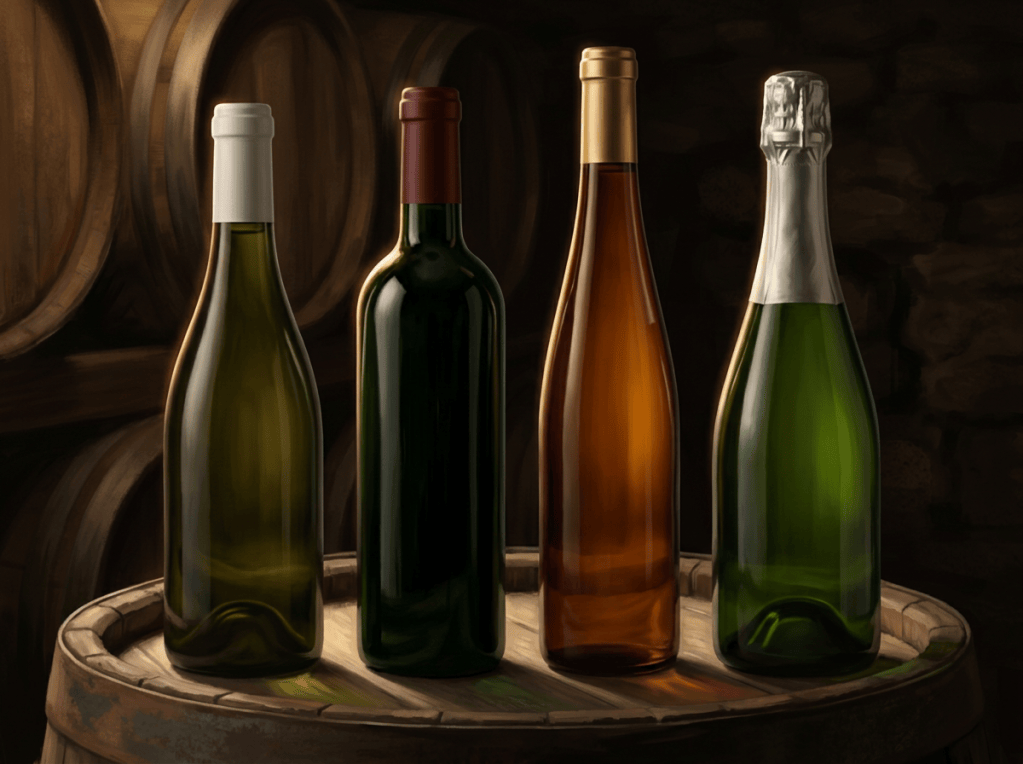
The Burgundy: Sloping Shoulders and Quiet Confidence
Octavius lifts the first bottle out of its bag as though unveiling a sculpture.
The Burgundy bottle has:
- gently sloping shoulders that flow into the neck
- a wide, slightly rounded body
- traditionally, a soft yellow-green glass colour the French call feuille morte — “dead leaf”
It is generally considered the older of the two great French shapes. One popular theory holds that the gentle curve was simply easier for glassblowers to make — no awkward corner where the shoulder meets the neck.
“It is the bottle of Pinot Noir and Chardonnay,” Octavius says. “And because those two grapes travelled the world, the bottle travelled with them. Find a Chardonnay from Walker Bay or an Oregon Pinot Noir, and nine times out of ten it will be wearing Burgundian clothing.”
Here is where it gets interesting. Burgundy labels traditionally don’t name the grape at all. A bottle says Meursault or Gevrey-Chambertin and assumes you already know what grows there.
“Which is terribly unhelpful,” Isabella says.
“It is terribly French,” Octavius corrects. “But the bottle compensates. The shape is the clue the label refuses to give you.”
The Burgundy shape also has some well-dressed cousins:
- The Rhône bottle — almost identical, but often a little slimmer. Syrah, Grenache and Viognier from the Rhône (and many Rhône-style wines elsewhere) live in it.
- Châteauneuf-du-Pape — since the 1930s, many of its producers have used a bottle embossed with the papal crest: the crossed keys of Saint Peter beneath the papal tiara.
- Barolo and Barbaresco — Piedmont producers often use the Albeisa bottle, a sloping-shouldered shape revived in 1973 from an 18th-century design, with the word “Albeisa” embossed in the glass.
“You can feel Barolo in the dark,” Octavius says with some satisfaction.
“You can feel a lot of things in the dark,” Koos mutters. “Doesn’t mean you should.”
The Bordeaux: Square Shoulders and a Sediment Story
The second bag comes off to reveal the most recognisable wine bottle on earth: straight sides, high, square shoulders, and a short neck.
Look at any bottle-store shelf in the world and the Bordeaux bottle will be the majority shape. It holds Cabernet Sauvignon, Merlot, Cabernet Franc, Malbec, Petit Verdot, and the Bordeaux whites — Sauvignon Blanc and Semillon. And then, because it is so universal, it holds almost everything else too.
Why the shoulders? There are two competing explanations, and the honest answer is that nobody knows for certain.
The practical theory: Bordeaux reds are built on tannic, long-lived grapes that throw sediment as they age. When you pour carefully from a bottle that has been lying on its side, those sharp shoulders act as a dam, catching the gritty deposit before it reaches your glass.
The rivalry theory: Bordeaux simply wanted its wines to look nothing like Burgundy’s.
“Both are plausible,” says Octavius. “And knowing Bordeaux and Burgundy, both are probably true.”
The colour of the glass in Bordeaux follows its own quiet code:
- dark green for the reds
- lighter green for the dry whites
- clear glass for Sauternes and Barsac, so you can see that glorious golden colour
Isabella taps the shoulder of the bottle.
“Here is something you won’t know,” she says. “Go into a bottle store in Spain and look at the Rioja section. Most of those bottles are Bordeaux-shaped. That’s no accident.”
In the 1860s and 1870s, phylloxera and mildew devastated Bordeaux. French négociants crossed the Pyrenees looking for wine, and some Bordelais winemakers came with them, bringing barrels, techniques — and bottles. Rioja has worn Bordeaux’s shape ever since.
“And the wire?” Koos asks, pointing to the fine golden mesh some Rioja bottles still wear.
Isabella smiles. “Alambrado. In the late 19th century, the wire was tied on so nobody could swap the wine inside without breaking it. An anti-fraud device. Today, it’s pure romance.”
The Flute: Tall, Slim and Protected by Law
The third bag is the giveaway. Even wrapped in paper it towers over the others: long, slender, with a gently tapering neck.
This is the flute — known in Germany as the Rhine or Mosel bottle and in France as the flûte d’Alsace. It is home to Riesling, Gewürztraminer, Pinot Gris, Sylvaner and Muscat.
“A bottle so tall it won’t stand up in the fridge door,” Koos says. “Who designed this?”
“Sailors, possibly,” Octavius replies. “Rhine and Mosel wines were shipped along the rivers in boats, and a tall, slim bottle packs efficiently. They also tended to be lighter, fresher wines that weren’t laid down for decades, so sediment-catching shoulders weren’t needed.”
In Alsace the flute isn’t a tradition. It’s the law. The Alsace appellation rules require its wines to be bottled in this tall shape, which the regulations formally call the vin du Rhin bottle.
And here’s a detail to impress your friends: in Germany, the colour of the flute was traditionally a regional clue on its own.
- brown glass for the Rhine regions (such as the Rheingau)
- green glass for the Mosel
“So,” Isabella says, “a brown flute and a green flute could tell you which river you’re drinking from.”
“Traditionally,” Octavius adds. “Modern producers have muddied the water somewhat. Or muddied the river.”
Koos groans.
The Champagne: Built Like a Pressure Vessel
Isabella finally slides the fourth bottle out of its bag and holds it up. It is broad, gently sloped like a Burgundy, but noticeably heavier, with a punt deep enough to lose your thumb in.
“This bottle,” she says, “is carrying a secret. About six atmospheres of pressure.”
That is roughly three times the pressure in a car tyre, pressing against every square centimetre of glass. And the bottle has to hold it for years.
This is why sparkling wine bottles are made of much thicker glass, why they have that deep punt (a domed base spreads the pressure, the same way an arch spreads weight), and why they are among the heaviest bottles in your cellar.
The early days were dangerous. When Champagne first started to sparkle in the 17th century — usually by accident, when fermentation restarted in the bottle as spring warmed the cellars — French bottles simply couldn’t cope. They shattered. One bursting bottle could set off a chain reaction down a whole row, and cellar workers took to wearing protective masks.
“And who had glass strong enough to survive the pressure?” Isabella asks, with a mischievous look at Octavius.
He sighs. “The English. With their coal furnaces.”
English merchants imported still Champagne in barrels and bottled it in their tough verre anglais. In 1662 an English scientist named Christopher Merret even presented a paper describing how adding sugar to wine made it brisk and sparkling. The French only adopted the coal-fired, English-style bottle after 1700.
“So Dom Pérignon didn’t invent Champagne?” Koos asks.
“Dom Pérignon,” Octavius says gently, “spent a good deal of his career trying to stop the wine from fizzing.”
Koos looks delighted. “Best story so far.”
Today, the same principle applies to every bottle-fermented sparkling wine — Champagne, Cava, Franciacorta, and our own Cap Classique. When your wine has six atmospheres of ambition, you need a bottle with a backbone.
Shoulders, Punts and Paunches: The Fine Print
Once you start looking closely, the “big four” aren’t as uniform as they first appear.
Shoulders vary. Many premium Bordeaux-style bottles have taller, broader, more sharply sculpted shoulders than everyday versions. Some flare slightly outwards. These details mean nothing to the wine, but they mean a great deal to the marketing department.
Punts vary. The punt — that dimple in the base — is one of wine’s great debating points. Theories include:
- strength, especially for sparkling wine
- stability, because a bottle with a domed base won’t rock on an uneven table
- a leftover from glassblowing, where the rough mark of the glassblower’s rod was pushed inwards so the bottle could stand
- a convenient spot to collect sediment
- a handhold for the sommelier’s thumb when pouring
“And the deeper the punt, the better the wine?” Koos asks.
“The deeper the punt,” Octavius says, “the bigger the glass order.”
Weights vary — enormously. An empty 750ml bottle can weigh anywhere from about 300g to 900g. Some “prestige” bottles feel like you’ve picked up a dumbbell.
“That,” says Isabella, “is no accident either. People associate heavy bottles with expensive wine.”
There’s some truth in that perception — research has found a correlation between bottle weight and price. But it comes at a cost. Glass is the single largest source of carbon emissions in the wine industry, and more glass means more fuel to melt it and more fuel to ship it.
Koos picks up a feather-light bottle of everyday red and an absurdly heavy one side by side.
“Same amount of wine,” he says. “One just goes to the gym.”
The good news: lightweight bottles are quietly gaining ground, and consumers increasingly see unnecessarily heavy bottles as a bit embarrassing rather than impressive.
Why 750ml? (Nobody Is Entirely Sure)
Here’s a question that should be easy. Why does a standard bottle hold 750ml? Not a litre. Not half a litre. Three-quarters.
The legal answer is straightforward. In 1975, a European packaging directive standardised wine bottle sizes, and 75cl became the standard for bottles in that range. The United States followed when its metric sizes for wine came into force in 1979. Before that, Americans bought wine by “the fifth” — a fifth of a US gallon.
But why 750ml? Here’s where the stories get creative:
- The British theory. England was Bordeaux’s most important customer, and the British traded wine in imperial gallons. An imperial gallon is about 4.5 litres. Divide it by six and you get roughly 750ml — so a case of 12 bottles was a tidy two gallons.
- The barrel theory. A Bordeaux barrique holds 225 litres — which fills exactly 300 bottles of 750ml, or 25 cases of 12. Neat. Suspiciously neat.
- The tavern theory. Six generous glasses of 125ml per bottle — a classic serving measure.
- The glassblower theory. A favourite at dinner parties: 750ml was supposedly the average lung capacity of a glassblower in a single breath. It’s a lovely story. There is no evidence for it whatsoever.
“I like the glassblower one,” Koos says.
“Of course you do,” says Octavius. “It is the only one that is definitely untrue.”
The Colour of the Glass
Green, brown or clear — glass colour started as a matter of chemistry (iron and other impurities in the sand), but it carries real consequences.
Wine is surprisingly sensitive to light. Exposure to UV and blue light can trigger a reaction between naturally occurring compounds in the wine — riboflavin and sulphur-containing amino acids — producing unpleasant cabbage-like or wet-cardboard aromas. The French call it goût de lumière: the taste of light. Wine people call it “light strike.”
- Brown (amber) glass offers the best protection
- Dark green offers good protection
- Clear (flint) glass offers almost none
So why use clear glass at all?
“Because some wines are meant to be seen,” Isabella says. “A pale Provence rosé, a golden Sauternes — the colour is part of the seduction.”
“Which is why,” Octavius adds, “a clear bottle of rosé should never be left in the shop window.”
Koos nods. “Or on the stoep in the sun. Ask me how I know.”
The Hat Tells a Story: Capsules
The capsule — the foil sleeve over the cork — started life as a practical cover to protect the cork from cellar rats, insects and weevils. For a long time, these were made of lead, until health concerns saw lead capsules phased out in the early 1990s in favour of tin, aluminium and plastic composites.
“And the colours?” Koos asks. “Red capsule for red wine, gold for whites — isn’t that a rule?”
Octavius shakes his head.
“A convention, at best,” he says. “In most of the world, capsule colour is the marketing department’s choice. There is no universal code.”
But there are some fascinating exceptions:
- France uses the capsule as a tax stamp. French wines sold in France carry a small round seal on top (the CRD, a tax-paid capsule featuring Marianne). Traditionally, a green top meant appellation wine and a blue top meant ordinary table wine. Since 2011, most still wines can use a wine-red (lie-de-vin) top instead — but Champagne must keep its green top.
- Germany has the Goldkapsel — the gold capsule. Some top Mosel and Rhine estates use a gold capsule (and sometimes a “long gold capsule”) to mark their very best selections.
- Some estates create their own code. The Mosel’s Markus Molitor, for example, uses white, green and gold capsules to indicate the wine’s style, from dry to sweet — so the capsule tells you what the label doesn’t.
“So in a blind tasting,” Isabella says, “if somebody forgets to cover the capsule…”
“…you check the capsule first,” Koos finishes. “Then you pretend you got it from the nose.”
The Blind-Tasting Detective
Which brings us back to Koos’s brown paper bags.
In a properly run blind tasting, the bottle is completely disguised, or the wine is poured out of sight. But at a relaxed tasting among friends — with bottles in socks, bags or wrapped in foil — an observant taster can learn a surprising amount before the first sip:
- Sloping shoulders suggest Pinot Noir, Chardonnay, or a Rhône-style wine
- High, square shoulders suggest Bordeaux varieties — or a Rioja, or almost anything else from the New World
- A tall, slim silhouette points strongly to Riesling, Gewürztraminer or Pinot Gris
- A broad, heavy bottle with a deep punt suggests sparkling wine — or an ambitious red
- Bag weight hints at the price category (and the producer’s ego)
- An embossed crest felt through thin paper can give away a Châteauneuf-du-Pape or a Barolo
“But it’s a clue,” Octavius cautions. “Not a verdict. A good taster uses the bottle to form a hypothesis, then lets the wine prove or disprove it.”
Because the traps are everywhere:
- Plenty of Australian Shiraz goes into Bordeaux bottles, while some cooler-climate Syrah — in Australia and here in the Cape — wears Burgundy shapes.
- Italian Pinot Grigio usually lives in a Bordeaux bottle, while Pinot Gris made in the Alsace style lives in a flute.
- Some Sauvignon Blancs choose sloping shoulders to suggest Sancerre; others choose square shoulders to suggest white Bordeaux.
“In the Old World, the shape is often law or tradition,” Octavius says. “In the New World, it is a choice — and the choice tells you what the winemaker is trying to say.”
Koos grins. “And sometimes the winemaker is trying to fool you.”
So Where Does Pinotage Fit?
Koos pulls a fifth bottle from under the barrel and puts it down with a thump. Pinotage.
“Right, Professor. Here’s one for you. What bottle should this be in?”
Octavius considers it.
“Logically, a sloping shoulder,” he says. “Pinotage was created in 1925 by Professor Abraham Perold at Stellenbosch, by crossing Pinot Noir with Cinsaut — which South Africans then called Hermitage. Hence ‘Pinot-tage’. Its father is Burgundian. Its mother is from the south of France. Both families wear sloping shoulders.”
“Exactly,” says Koos. “So go and look at a Pinotage shelf.”
What you’ll find is a family argument in glass. Plenty of Pinotages wear Bordeaux bottles. Others wear Burgundy shapes. And unlike Burgundy or Alsace, there’s no rule and no long tradition to settle it.
“So which is right?” Isabella asks.
“Neither,” says Koos. “Both. It’s the winemaker’s call. Could be the glass supplier, could be the label design, could be what the rest of the range looks like.”
“Or perhaps,” Octavius suggests, “some winemakers are using the bottle to send a message.”
He picks up the Pinotage and turns it in the light.
“A producer who makes a big, ripe, oak-aged Pinotage in the image of Cabernet might feel at home in a Bordeaux bottle. One who wants to show off the grape’s perfumed, Pinot Noir side might reach for the sloping shoulders.”
“Might,” Koos says firmly. “I’ve tasted big Pinotage in Burgundy bottles and pretty ones in Bordeaux bottles. Don’t bet the braai money on it.”
“A hint, then,” Octavius concedes. “Not a promise.”
Isabella smiles. “Which is very South African. Pinotage doesn’t have a hundred years of tradition telling it what to wear. It gets to choose.”
The same freedom shows up across the Cape. Chenin Blanc, for instance, appears in Bordeaux bottles, Burgundy bottles and the occasional flute, and you could argue some producers use the shape as a hint of style. Learn your local producers, and the bottle might tell you a little more than you expected. Then again, it might not. That’s half the fun.
Koos Grenache Has the Final Word
Koos lines up the bottles on the barrel: Burgundy, Bordeaux, flute, Champagne, and his Pinotage in the middle.
“You know what I like about all this?” he says. “The bottle is the first thing you see and the last thing anyone thinks about. But it’s talking the whole time.”
He taps the shoulder of the Bordeaux bottle.
“This one says, ‘I’m serious, give me time.’”
He taps the Burgundy.
“This one says, ‘I’m elegant, don’t rush me.’”
The flute.
“This one says, ‘I’m going to fall over in your fridge.’”
And the Champagne.
“And this one says, ‘Stand back.’”
He picks up the Pinotage and pulls the cork.
“But in the end, the bottle is only the outfit. You still have to pour the wine to meet the person inside.”
The Uncorked & Curious Takeaway
Bottle shapes aren’t a law of nature. They are history you can hold in your hand — shaped by English warships, regional rivalries, river boats, Champagne’s explosive temper and, more recently, the marketing department. In much of Europe, the shape is fixed by tradition or law. In the New World — and especially in South Africa — it is a choice, and that choice tells you what the winemaker wants you to expect.
Isabella Rioja “A bottle is a passport. It tells you where the wine thinks it comes from.”
Professor Octavius Pinot “And a clue. Though never a conclusion.”
Koos Grenache “And sometimes it’s just a really heavy piece of glass.”
The Uncorked & Curious Bottle Spotter’s Guide
Not sure what you’re looking at? Let the shoulders do the talking.
Sloping shoulders, wide body (Burgundy) Octavius: “Elegance, perfume and patience.”
- Pinot Noir, Chardonnay
- Rhône reds and whites (in a slightly slimmer cousin)
- Barolo and Barbaresco (often in the Albeisa shape)
- Some South African Pinotage and Chenin Blanc
High square shoulders, straight sides (Bordeaux) Koos: “Serious wine. Probably wants a steak.”
- Cabernet Sauvignon, Merlot, Cabernet Franc, Malbec
- Sauvignon Blanc and Semillon
- Most Rioja
- Much Australian Shiraz, and plenty of South African Pinotage and Chenin Blanc
Tall and slim (Flute) Isabella: “Aromatic, fresh and beautifully dressed.”
- Riesling, Gewürztraminer, Pinot Gris, Muscat
- Compulsory in Alsace
- Traditionally brown for the Rhine and green for the Mosel
Broad, heavy, deep punt (Champagne) Koos: “Stand back. Open slowly.”
- Champagne, Cap Classique, Cava, Franciacorta and other bottle-fermented sparkling wines
Quick Clue Cues
- Clear glass? Probably rosé, sweet wine or a white built for early drinking
- Heavy bottle? Premium ambitions — though not necessarily a better wine
- Gold capsule on a German Riesling? Possibly the estate’s top selection
- Green tax seal on a French bottle bought in France? Champagne or appellation wine
Koos’ Final Word “If the bottle’s still in the bag, feel the shoulders. If it’s open, just drink it.”
Octavius’ Reply “Ideally, in that order.”
At Uncorked & Curious, we believe great wine doesn’t have to be complicated — but it’s always more interesting with a story. Raise a glass. Stay curious.


Leave a Reply