From barrel fermentation to the angel’s share — how barrel choice, cooperage craft and patience shape the wines we love, through the insights of Koos Grenache and Professor Octavius Pinot.
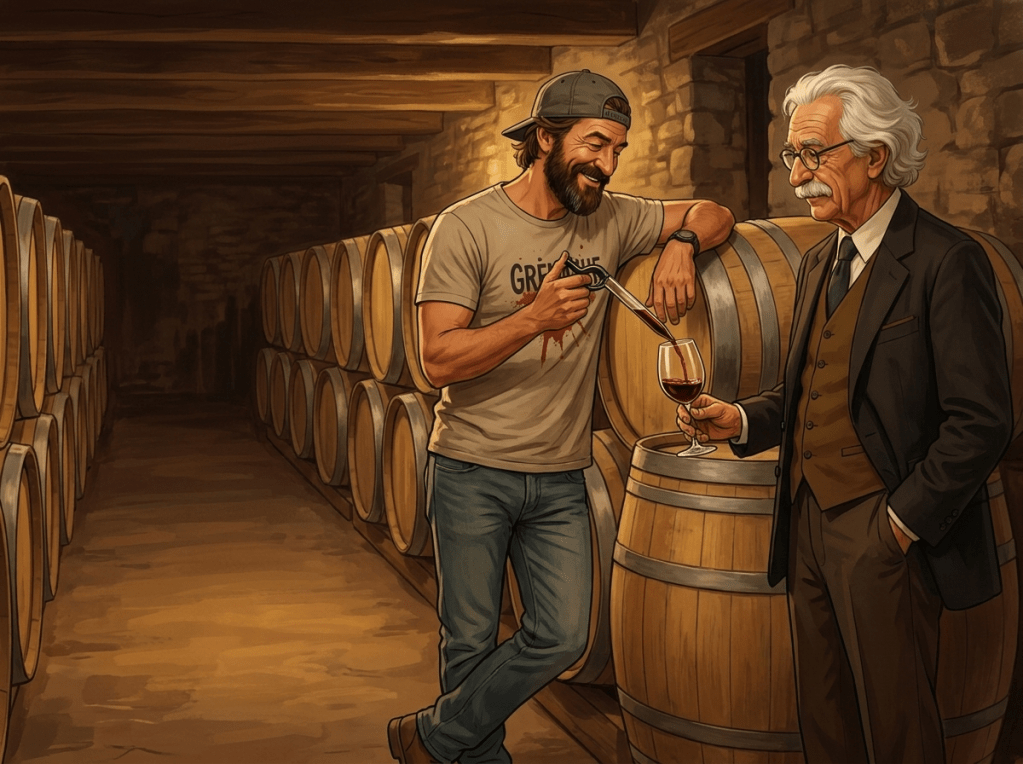
The cellar is cool and dim, the air carrying the quiet scent of wood, spice and something slowly evolving. Rows of barrels stretch into shadow. Koos Grenache draws a sample with a pipette (wine thief) and hands a glass to Professor Octavius Pinot.
Koos Grenache
“Ah, oak. The winemaker’s favourite hiding place. Get heavy-handed with it and suddenly everything tastes expensive.”
Professor Octavius Pinot
“Or, when used with restraint, it becomes invisible — which is precisely the point. The best oak integration should leave you wondering whether any oak was used at all.”
Koos
“If I can taste the tree before the grape, we’ve got a problem.”
Oak is not a flavouring. It is a slow, deliberate conversation between wood, air, time and wine.
What Oak Actually Does to Wine
Wine does not simply sit in oak — it interacts with it in three fundamental ways, each shaping the final character in the glass.
Octavius
“The barrel is an active participant. Dismiss it as mere storage and you’ve missed the point entirely.”
1. Micro-oxygenation: The Breath of Barrel Ageing
Oak staves are not airtight. Tiny amounts of oxygen permeate through the wood over the months or years of ageing. This controlled oxidation is transformative — it polymerises tannins, meaning individual harsh tannin molecules link together into longer, smoother chains. The result is a wine that feels rounder, softer and more harmonious on the palate.
This is micro-oxygenation in its most natural form. Some winemakers replicate this process in stainless steel tanks using oxygen-dosing equipment, but the barrel delivers it with greater nuance, since the rate of oxygen ingress fluctuates gently with temperature and humidity — mirroring the rhythm of the seasons.
2. Extraction of Oak Compounds
Oak wood is a complex chemical library. As wine sits against the staves, it dissolves a range of flavour- and structure-active compounds:
- Vanillin — the compound that gives American oak its characteristic vanilla note
- Ellagitannins — wood tannins that add structure and contribute to ageing potential
- Lactones (β-methyl-γ-octalactone) — responsible for the coconut and sweet spice notes common in American oak
- Guaiacol and 4-methylguaiacol — smoky, toasty notes derived from lignin breakdown during barrel toasting
- Eugenol — spice notes reminiscent of cloves
- Furfural and 5-methylfurfural — caramel and sweet bread notes from toasted hemicellulose
Koos
“So every barrel is essentially its own spice rack. And the winemaker’s job is to decide how much seasoning the wine needs.”
3. Physical Concentration
As the angel’s share evaporates — typically between 2% and 5% of barrel volume per year in South African cellars — the wine gradually concentrates. This is why some barrel-aged wines feel so much more intense and structured than their tank-fermented equivalents. Evaporation is not waste; it is a form of refinement.
Oak Has Terroir Too
Wine lovers obsess over the terroir of vineyards, but the terroir of forests is equally important. The origin of oak wood shapes its grain density, chemical composition and the flavours it imparts to wine.
Octavius
“Quercus petraea — the sessile oak — grows slowly in the forests of central France. Quercus robur grows faster and tends toward coarser grain. These are not interchangeable. And then there is Quercus alba from North America, an entirely different species with its own character.”
| Forest / Origin | Character & Use |
|---|---|
| Tronçais | The finest-grained French forest. Slow-growing trees produce tight, dense staves that release flavour with great restraint and elegance. Prized for Pinot Noir and Chardonnay. |
| Nevers | Firm-grained with a notable spicy character. Robust structure makes it popular for Cabernet Sauvignon and Syrah. |
| Vosges | Aromatic lift with floral and spiced notes. Slightly more expressive than Tronçais; good versatility across varieties. |
| Allier | Medium grain; a classic all-rounder used widely across Burgundy and Bordeaux. |
| Limousin | Wider grain than other French forests; faster extraction. Historically used for Cognac maturation rather than fine wine. |
| Slavonia (Croatia) | Large-format casks only. Very tight grain, minimal flavour contribution; allows gentle oxidation over many years. Beloved in Piedmont for Barolo and Barbaresco. |
| Caucasian (Georgia/Russia) | Increasingly explored. Tight-grained with a distinctive aromatic profile; gaining ground in avant-garde cellars. |
| American (Quercus alba) | Widest grain; fastest, most obvious extraction. Vanilla, coconut and sweet spice. Important in Rioja, Sherry and many New World styles. |
Koos
“So now we’re drinking forests as well as vineyards. At this rate I’ll need a map in the cellar.”
French Oak vs American Oak: A Study in Contrast
No comparison in winemaking is more debated. Both have earned their place, but they serve fundamentally different stylistic ends.
| Characteristic | French Oak | American Oak |
|---|---|---|
| Species | Quercus petraea / Quercus robur | Quercus alba |
| Grain | Tight | Wide |
| Flavour extraction speed | Slow, subtle | Fast, pronounced |
| Primary flavour notes | Cedar, spice, subtle vanilla, tobacco | Vanilla, coconut, dill, sweet spice |
| Tannin character | Fine-grained, structural | Softer, rounder |
| Approximate cost (new barrique) | R18,000–R30,000+ | R8,000–R18,000 |
| Classic applications | Burgundy, Bordeaux, premium SA Chenin & Cabernet | Rioja, Sherry, Penfolds Grange, many New World styles |
The South African wine industry has broadly embraced French oak for its premium wines. The intensity of South African sunshine and the ripeness it delivers mean that adding the full-throttle flavour of American oak can overwhelm the wine’s natural fruit character. French oak whispers where American oak speaks.
That said, the rule has celebrated exceptions. Penfolds Grange — arguably the southern hemisphere’s most iconic red wine — has long used American oak to magnificent effect. The key, as always, is mastery of the tool rather than the tool itself.
Why Not South African Oak?
Octavius
“A question I am asked at every seminar. South African oak species do exist. But there are reasons they haven’t found their way into the cellar.”
South African indigenous tree species lack the properties that make European and American oaks suited to winemaking. Planted European oak does exist in South Africa, but the climate promotes faster growth, resulting in wider grain rings and a less predictable tannin and flavour profile than slow-grown European equivalents. Some experimental work is ongoing, but commercial viability remains distant.
Koos
“Fine for furniture. Not ideal for fine wine. At least not yet.”
From Forest to Barrel: The Art of the Cooper
A great barrel begins long before a single stave is shaped. The craftsmanship of cooperage is one of winemaking’s most underappreciated arts.
Splitting, Not Sawing
Premium barrel staves are riven — split along the natural grain of the wood — rather than sawn. Splitting follows the wood’s cell structure, preserving its integrity and preventing the micro-channels that carry water in living trees from being opened up. Sawn staves allow wine to penetrate more deeply and unevenly; riven staves provide a more controlled, consistent surface.
Air Drying: The Patience of Good Cooperage
After splitting, staves are stacked outdoors in the cooperage yard for a minimum of 18 months, and often 24 to 36 months for the finest barrels. Rain leaches out the harshest, most astringent tannins. Sun and wind dry the wood gradually and evenly. This slow seasoning cannot be rushed in a kiln without sacrificing the subtlety that makes premium oak worth the price.
Octavius
“A cooperage that skips proper air drying is selling you bitterness at a premium price.”
Bending and Toasting: Fire as Flavour
Once dried, the staves are shaped over an open flame. Heat makes the wood pliable enough to bend into the barrel’s characteristic curve. This toasting step is also where some of the most important flavour chemistry happens — the Maillard reaction and caramelisation of wood sugars create the aromatic compounds the winemaker is seeking.
- Light toast (LT) — Preserves more natural wood tannin and structure; subtle vanilla; used when the winemaker wants the wine, not the wood, to dominate.
- Medium toast (MT) — The most widely used level; a balance of spice, vanilla and structure with reduced harsh tannins.
- Medium-plus toast (MT+) — Greater complexity, smoke, mocha and coffee notes; popular for full-bodied reds.
- Heavy toast (HT) — Significant smoke, char and bitter chocolate; can add grip and intensity but risks masking delicate fruit.
Koos
“And occasionally overdone. I’ve tasted wines that smelled like a braai had been held inside the barrel.”
Barrel Sizes: Surface Area and Influence
The relationship between barrel size and oak influence is a matter of physics as much as winemaking philosophy. Smaller vessels mean more oak contact per litre of wine; larger vessels mean gentler, slower integration.
| Vessel | Character & Application |
|---|---|
| Barrique (225 L) | The Bordeaux standard; high surface-area-to-volume ratio; pronounced oak and faster evolution. Often used for 12–18 months. |
| Hogshead (300 L) | A more balanced ratio than the barrique; growing popularity in South Africa. |
| Puncheon (500 L) | Subtler oak, more fruit expression, gentler oxygen exchange. Popular for Pinot Noir and aromatic whites. |
| Demi-muid (600 L) | Common in the Rhône Valley; excellent for preserving varietal character while adding structure. |
| Foudre (1,000–5,000 L) | Minimal flavour contribution; used primarily for gentle, slow oxidative maturation. Favoured by natural wine producers and for wines like Vega Sicilia. |
| Amphora / Clay jar (varies) | An ancient vessel making a modern comeback. No oak character at all, but allows a unique form of micro-oxygenation through porous walls. |
Octavius
“Surface area per litre is the number winemakers carry in their heads. A 225-litre barrique exposes each litre of wine to roughly 80 square centimetres of wood. A 500-litre puncheon drops that to around 60. The difference, over 18 months, is considerable.”
Koos
“So the bigger the barrel, the less the wine has to deal with. Sometimes restraint in the cellar is the bravest choice.”
New, Second Fill and Neutral: Managing Oak Intensity
A barrel’s flavour contribution diminishes with each successive use. A new barrel delivers its most powerful punch; subsequent uses progressively dial down the oak flavour while still contributing to the wine’s structural evolution through gentle micro-oxygenation.
| Fill Number | Character |
|---|---|
| New oak (1st fill) | Maximum flavour extraction; tannin, vanilla, spice; can overpower lighter wines. |
| Second fill | More integrated and subtle; flavour still present but softened and better-merged with fruit. |
| Third fill | Largely structural; minimal flavour; primarily used for gentle oxygenation. |
| Fourth fill and beyond | Effectively neutral; the barrel is used almost entirely for its physical properties. |
Skilled winemakers blend across fill numbers the way they blend across varieties or vineyard blocks. A wine matured in 50% new oak and 50% second- or third-fill barrels will have very different complexity than one aged entirely in new oak — and is often the better wine for it.
Octavius
“Vega-sicilia — one of the world’s great wines — spends years ageing before release. Mostly older barrels. The result is not an oaky wine; it is a wine of extraordinary presence that has simply had time.”
Koos
“Which proves the point. Great wine is about balance, not volume.”
Barrel Fermentation: Where Oak Becomes Foundation, Not Decoration
There is a crucial distinction between fermenting wine in barrel and simply maturing it there. When fermentation occurs inside the barrel, the interaction between the wine and the wood is more fundamental — the aromatic compounds integrate at the molecular level rather than being added to an already-formed wine.
Octavius
“When wine ferments in barrel, the oak becomes part of its foundation, not something applied on top. The difference in the glass is profound.”
Chardonnay: The Great Beneficiary
Barrel fermentation is most associated with Chardonnay. A well-made barrel-fermented Chardonnay will show seamless oak integration that tank-fermented equivalents cannot achieve, regardless of how long they subsequently spend in wood.
After fermentation, most quality Chardonnay spends additional time on its lees — the spent yeast cells that remain after fermentation. Winemakers periodically stir these lees in a technique known as bâtonnage (from the French bâton, meaning stick). The result is a wine with greater creaminess, a characteristic brioche or bread-dough richness, and enhanced texture and mouthfeel. The lees also act as a protective buffer, reducing the wine’s exposure to oxygen and helping the oak integrate more gently.
The spectrum of oaked Chardonnay styles runs from:
- Fully barrel-fermented and matured on lees with bâtonnage — rich, creamy, textural, complex (classic Burgundy, premium Stellenbosch Chardonnay)
- Tank-fermented then transferred to barrel for maturation — some integration but more structural in character
- Unoaked Chardonnay — pure fruit, linear, often mineral; a legitimate and delicious style, not a lesser one
Koos
“Not every white wine needs a barrel. Some varietals — Sauvignon Blanc, Riesling, Pinot Gris in certain styles — are simply better off without one. The question is always: what does this wine want to be?”
Red Wine Fermentation: Why It’s Different
Red wines ferment with their grape skins, which rise to form a cap on top of the fermenting liquid. This cap must be regularly broken up and submerged to extract colour, tannin and flavour — processes known as pump-over (remontage) or punch-down (pigeage). Managing this in a large open-top fermentation vessel is practical. Doing it inside a 225-litre barrique is not. For this reason, red wines almost universally ferment in tanks before being transferred to oak for maturation.
Koos
“Try managing a cap inside a small barrel and you’ll need a very small winemaker. Or a very long arm.”
The Economics of Oak: Cost, Care and the Angel’s Share
Oak maturation is among the most expensive decisions a winemaker makes. Understanding the economics explains why barrel-aged wines command a premium, and why not every wine should be put in oak at all.
| Vessel | Approximate Cost (ZAR) |
|---|---|
| New French oak barrique (225 L) | R18,000 – R30,000+ |
| New American oak barrique (225 L) | R8,000 – R18,000 |
| New French puncheon (500 L) | R25,000 – R45,000 |
| Second-fill French barrique | R5,000 – R10,000 |
| Neutral / old wood (5+ fills) | R2,000 – R5,000 |
A single barrel offers only a few vintages of meaningful oak flavour — typically two to four years before it is considered second or third fill. Cellar space, maintenance, labour and the losses to evaporation all add to the cost.
The angel’s share — the poetic term for evaporation through the barrel staves — typically accounts for 2 to 5% of barrel volume per year in South Africa, with higher losses in warmer, less humid cellars. To manage this, winemakers top up (ouillage) barrels regularly, adding wine from the same batch to replace what has evaporated. Failure to top up leaves an air gap above the wine, which invites volatile acidity, bacterial spoilage and, ultimately, vinegar.
Koos
“So the angels get their cut, and the winemaker keeps refilling the glass. It’s a fair arrangement, most of the time.”
Oak Alternatives: Legitimate Tool or Corner Cut?
The wine industry has long debated the legitimacy of oak alternatives — chips, staves, cubes, spirals and powder — as a substitute for barrel maturation. The debate is more nuanced than many purists admit.
| Alternative Format | Character & Use |
|---|---|
| Oak chips | Small fragments added to wine in tank; very fast extraction; used in entry-level production. |
| Oak staves / inserts | Planks suspended in tanks; greater surface area than chips; better flavour integration; longer contact time. |
| Oak cubes | Slower extraction than chips; greater control over contact time. |
| Oak powder / dust | Maximum surface area; fastest extraction; primarily for commercial bulk wines. |
What alternatives can do: add flavour compounds — vanilla, spice, some tannin — quickly and cheaply. What they cannot do: replicate the slow, transformative micro-oxygenation that occurs through the barrel stave over months or years. The chemistry of flavour can be approximated; the physics of slow oxidation cannot.
Octavius
“Some producers use oak chips or staves. While they add flavour, they cannot replicate the slow oxygen exchange of a barrel. The wine gains the flavour without the maturation.”
Koos
“Ah, the express lane to oak character. Useful, occasionally. Sufficient, rarely.”
Matching Oak to Variety: A Practical Guide
Not all grape varieties respond equally to oak treatment. The winemaker’s skill lies in understanding which varieties welcome oak and which are overwhelmed by it.
| Variety | Affinity with Oak |
|---|---|
| Cabernet Sauvignon | Classic affinity; high tannin and structure welcome complementary wood compounds; ageing potential extended significantly. |
| Merlot | Softer than Cabernet; benefits from gentle oak; over-oaking can strip freshness. |
| Syrah / Shiraz | Works well with both French and American oak depending on style; full-bodied and spicy varieties can hold significant oak influence. |
| Pinot Noir | Highly sensitive; subtle French oak in moderate proportions; heavy or American oak overwhelms the delicate varietal character. |
| Grenache | Often benefits more from older, neutral wood or concrete; its fruit purity can be obscured by new oak. |
| Chardonnay | Greatest white wine beneficiary of barrel fermentation and maturation; must be managed carefully to avoid heavy-handedness. |
| Chenin Blanc | South Africa’s most exciting oak partnership; aged Chenin in older French wood develops extraordinary complexity and longevity. |
| Sauvignon Blanc | Generally unoaked; occasional light oak can add texture but risks obscuring the variety’s signature aromatic lift. |
| Viognier | Occasional use of neutral or lightly-toasted French wood can enhance the variety’s floral and peachy character. |
| Riesling | Rarely oaked; the variety’s acidic precision and delicate aromatics are ill-suited to oak influence. |
Tasting Oak in Wine: Learning to Read the Barrel’s Signature
Understanding what to look for in the glass is the bridge between theory and pleasure. Oak manifests in three dimensions: aroma, taste and texture.
Aromatic Markers
- Vanilla — the most easily recognised sign of oak, particularly American oak
- Toast and smoke — from barrel toasting; heavier in heavily toasted wood
- Cedar and sandalwood — classic French oak signature
- Coconut and dill — hallmarks of American oak, particularly in white wines
- Clove and spice — eugenol from the wood, particularly from medium-toasted French oak
- Mocha and coffee — from heavily toasted wood; common in full-bodied reds
- Butterscotch / caramel — diacetyl from malolactic fermentation combined with oak compounds
Textural Markers
- Creaminess — from lees contact and bâtonnage in barrel-fermented whites
- Silkiness — from the polymerisation of tannins during oxidative ageing
- Grip — from ellagitannins extracted from new oak staves
- Length — oak tannins and structure extend the finish of barrel-aged wines
Octavius
“When you can no longer identify the oak separately from the wine — when it has become simply part of the wine’s personality rather than a layer on top of it — that is when the winemaker has done their job.”
The Final Word: Balance Above All
Oak is one of winemaking’s most powerful tools. Like all powerful tools, it is at its best when wielded with precision and restraint. The greatest barrel-aged wines in the world — from the grand crus of Burgundy to the icon wines of Stellenbosch, from Vega Sicilia to Penfolds Grange — do not announce their oak. They express their grape, their vineyard and their vintage, and the oak has done its work invisibly.
That invisibility is the point. And achieving it requires centuries of cooperage knowledge, the right wood from the right forest, toasted to the right level, in the right size vessel, for the right amount of time, for the right variety, from the right vintage.
The cellar door never gives away its secrets easily.
Koos
“A good barrel doesn’t shout. It just quietly makes the wine better.”
Octavius
“And a great winemaker knows when to stop listening to the oak and start listening to the wine.”


Leave a Reply