Or: how a professor’s experiment became a national talking point.
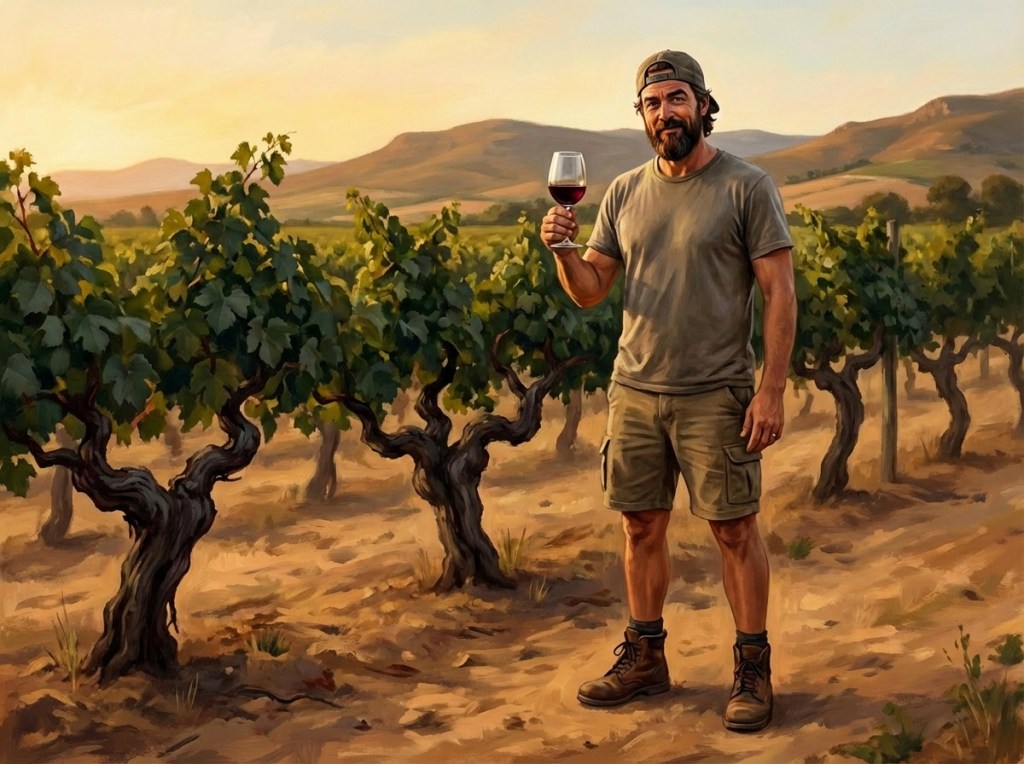
Koos Grenache leans back, glass in hand.
“Pinotage,” he says, “is the wine everyone thinks they understand — until they taste a good one.”
Professor Octavius Pinot clears his throat.
“Or until they understand why it exists at all.”
And that’s where the story really begins.
Why Pinotage Exists at All
To understand Pinotage, you have to return to the 1920s — and to Professor Abraham Izak Perold, South Africa’s first Professor of Viticulture at Stellenbosch.
At the time, South African vineyards faced a practical problem:
- Pinot Noir had already been planted, but it was notoriously difficult — low yielding, disease-prone, and inconsistent in local conditions.
- Cinsaut (then commonly known as Hermitage) was robust, drought-tolerant, and productive — but rarely profound.
Perold wasn’t trying to create a national icon. He was trying to solve a viticultural problem.
His idea was straightforward for the era:
Could Pinot Noir’s finesse be combined with Cinsaut’s resilience?
So in 1925, he crossed Pinot Noir & Cinsaut — and Pinotage was born.
Ironically, Perold nearly forgot about it. The seedlings were discovered years later, rescued from neglect, and quietly propagated. Pinotage entered the world without ambition or hype.
Koos smiles.
“Very on brand, actually.”
The Difficult Years: Quantity Over Quality
For much of the 20th century, Pinotage struggled — not because it was inherently flawed, but because of how it was treated.
- High yields were encouraged
- Vineyards were pushed hard
- Cellars chased colour, power, and alcohol
The result was a style that could smell burnt, rubbery, solvent-like, or simply aggressive.
These wines did lasting damage to Pinotage’s reputation — both locally and abroad.
Octavius adjusts his glasses.
“Pinotage,” he says gently, “was often judged at its worst, not its best.”
The Turning Point: Learning to Listen
Things began to change in the late 1990s and early 2000s, when winemakers stopped asking how much Pinotage they could make — and started asking how it wanted to be grown and handled.
Important lessons emerged:
- Pinotage dislikes overcropping
- Older vines matter
- Gentle extraction beats brute force
- Balance matters more than alcohol
- Oak should support, not dominate
Handled with care, Pinotage revealed a very different personality: dark fruit, spice, earthiness, savoury depth, and a distinctly South African character.
Koos nods.
“Stop shouting at it,” he says, “and it starts talking back.”
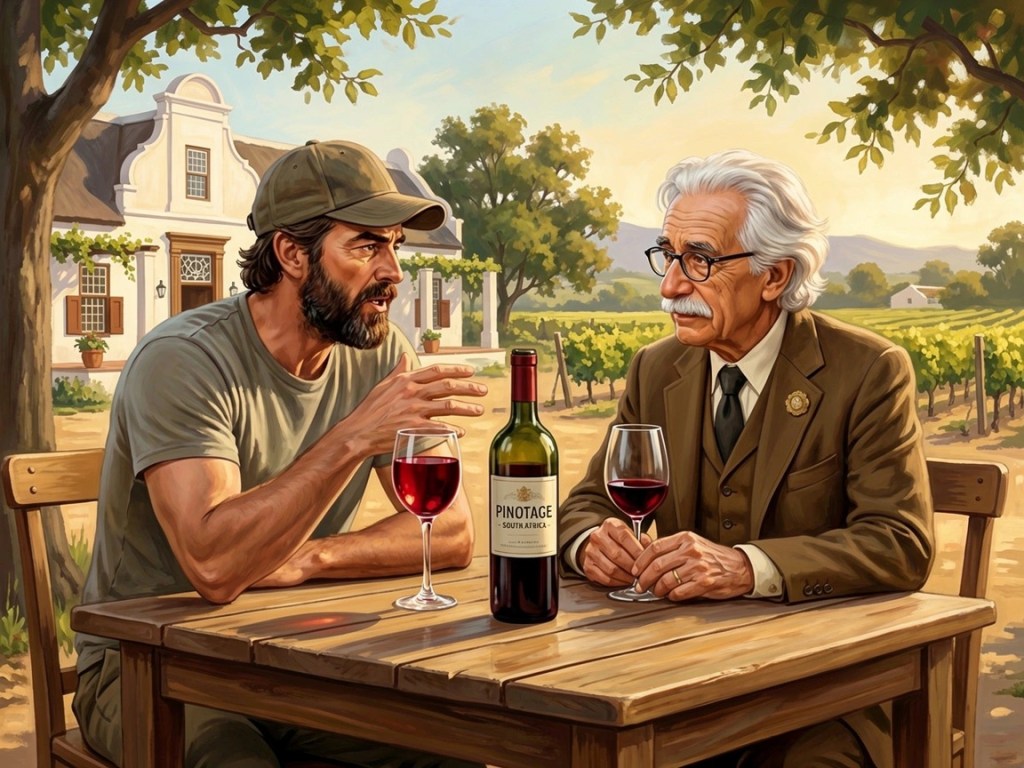
Koos vs Octavius: The Pinotage Debate
Koos Grenache:
“Let’s be honest, Professor — Pinotage only got interesting when people stopped trying to make it behave.”
Professor Octavius Pinot:
“I would argue it became interesting when we finally understood its limits — and respected them.”
Koos:
“That’s a very academic way of saying we used to bully it in the vineyard and beat it up in the cellar.”
Octavius:
“Not entirely inaccurate. Early Pinotage suffered from excessive yields and excessive extraction.”
Koos:
“And then you get producers like Kanonkop, proving that Pinotage can age, evolve, and sit comfortably among serious wines.”
Octavius:
“Indeed. Their work helped reposition Pinotage as a wine of structure and longevity.”
Koos:
“And yet they also make Kadette Rosé, just to remind us that Pinotage doesn’t always need to be serious to be good.”
Octavius (smiling):
“A valuable reminder. Pleasure and precision are not opposites.”
Koos:
“And then there’s Beyerskloof — practically synonymous with Pinotage. If someone says they hate Pinotage but haven’t tasted theirs, I suggest they try again.”
Octavius:
“Pinotage is not one wine. Judging it by a single experience is intellectually lazy.”
Koos:
“Exactly. Pinotage doesn’t hate drinkers. It hates shortcuts.”
Pinotage Styles Explained (With Buying Cues)
One reason Pinotage divides opinion is that it exists in many styles, often under the same name.
1. Fresh, Early-Drinking Pinotage
Style: Light to medium-bodied, minimal oak
Expect: Red cherry, plum, spice, freshness
Buying cue: Lower alcohol, younger vines, little oak
When: Casual meals, braais, lightly chilled
2. Classic, Age-Worthy Pinotage
Style: Structured, layered, built to mature
Expect: Dark fruit, savoury depth, spice, tannin
Buying cue: Old vines, respected producers (e.g. Kanonkop), some bottle age
When: With food, not too young
3. Cape Blends Featuring Pinotage
Style: Pinotage blended with Cabernet Sauvignon, Merlot or others
Expect: Texture, mid-palate weight, local character
Buying cue: “Cape Blend” on the label
When: For Pinotage-curious drinkers
4. Pinotage Rosé
Style: Dry, fresh, often underestimated
Expect: Strawberry, red berry, subtle savoury notes
Buying cue: Examples like Kanonkop Kadette Rosé
When: Summer, versatile food pairing
5. Experimental & Modern Pinotage
Style: Whole bunch, concrete, lighter extraction
Expect: Aromatic, transparent, surprising
Buying cue: Smaller producers, Swartland influence
When: If you enjoy exploration
**Koos Rants:
Why Pinotage Is Better Than Its Reputation**
“Most people who say they hate Pinotage,” Koos says, “aren’t actually talking about Pinotage. They’re talking about one bad bottle — often from years ago — and they’ve never checked whether things changed.”
He takes a sip.
“Pinotage didn’t fail. We failed Pinotage. We planted it everywhere, cropped it hard, chased alcohol and colour, and blamed the grape when the wine smelled like a tyre fire.”
Koos shrugs.
“But when you slow it down — old vines, sensible yields, gentle hands — Pinotage becomes honest. It tastes like where it comes from. It doesn’t pretend to be Pinot Noir. It doesn’t want to be Cabernet. It’s just… South African.”
He leans forward.
“And let’s be fair. Every wine country fiercely protects its awkward grapes. Italy has dozens. France built regions around them. Pinotage is ours.”
A pause.
“If Pinotage had been born in Burgundy, people would forgive it everything. But because it’s local, it has to be perfect.”
Koos smiles.
“Which is exactly why it deserves another chance.”
The Uncorked & Curious Takeaway
Pinotage is not one wine — it’s a spectrum.
From serious, age-worthy classics to fresh rosés and modern interpretations, Pinotage reflects how far South African wine has come — and how confident it has become in its own identity.
Koos Grenache:
“Pinotage doesn’t need everyone to love it.”
Professor Octavius Pinot:
“But it does deserve to be understood.”
Isabella Rioja:
“And tasted — more than once.”
 About Uncorked and Curious
Leave a comment