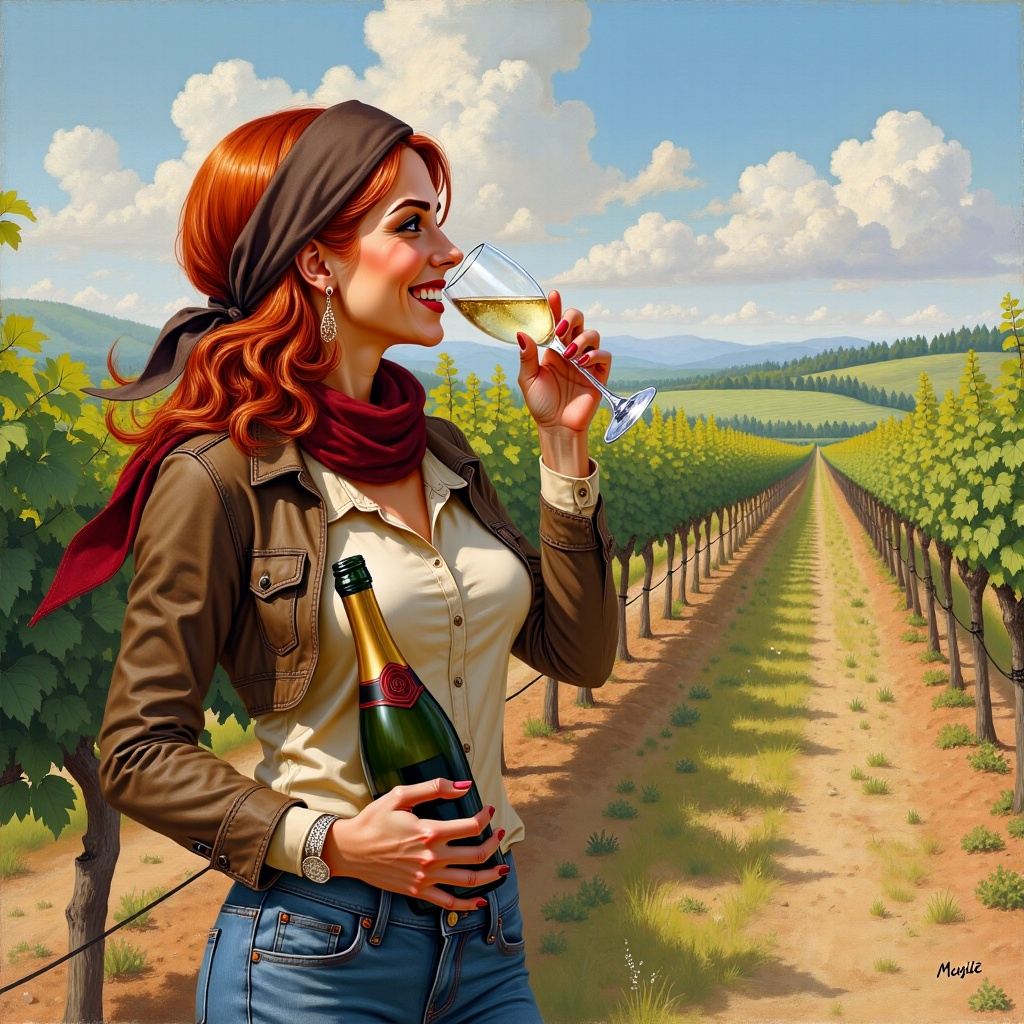
Nothing says celebration quite like the pop of a Champagne cork.
From royal weddings to Formula 1 podiums, Champagne has become a symbol of triumph, luxury, and joy.
But long before it filled crystal flutes in Parisian salons, its story began underground — in cool chalk cellars beneath France’s northernmost vineyards — and eventually spilled across oceans, inspiring new traditions in places like South Africa.
Today, we’re diving deep into the Champagne-region and its southern counterpart, Cap Classique — exploring how each is made, how they differ, and why they both deserve a place at your table.
So grab a glass — and let Octavius, Isabella, and Koos take you on a sparkling journey.
Octavius: “Let’s begin at the beginning…”
Champagne is produced exclusively in the Champagne region of France, about 150 km northeast of Paris.
The area is cool, misty, and defined by chalky soils that help vines survive harsh winters while storing precious heat in summer. It’s a demanding climate — and that struggle gives Champagne its piercing freshness.
Although bubbles were once considered a flaw, monks in Champagne eventually harnessed the phenomenon.
Dom Pérignon, a Benedictine monk at the Abbey of Hautvillers, is famously (though romantically) credited with exclaiming “Come quickly! I am tasting the stars!” when he first encountered sparkling wine.
That quote, sadly, is more myth than fact — but it captures the awe the early winemakers must have felt.
Over time, the méthode traditionnelle evolved, turning unpredictable fizz into a precise and codified craft.
Grape Varietals
Champagne primarily uses three noble grapes:
- Chardonnay — elegance, citrus, chalky precision
- Pinot Noir — structure, red-fruit depth
- Pinot Meunier — fruitiness, approachability
Most Champagnes are blends of these three, though many are varietal styles —
like Blanc de Blancs (Chardonnay only) or Blanc de Noirs (Pinot Noir / Pinot Meunier).
Octavius: “How Champagne is made — The Magic in the Bottle”
“Making Champagne isn’t just winemaking — it’s theatre, chemistry, and poetry bottled together. Every bubble tells the story of patience, precision, and a little bit of luck.”
1. The Base Wine
It all begins as a still, dry wine — light, acidic, and rather unremarkable on its own. Think of it as a blank canvas awaiting its transformation.
2. The Second Fermentation — Bubbles Born in the Bottle
Once the base wine is ready, it’s bottled with a small dose of sugar and yeast, known as the liqueur de tirage.
But here’s the marvel — the bottle is sealed with a crown cap, like a beer bottle, and the magic happens inside the very bottle you’ll later drink from.
As the yeast consumes the sugar, it produces carbon dioxide — and because the bottle is sealed, the gas dissolves into the wine.
That’s where every tiny, dancing bubble comes from. Not a machine. Not a tank. Nature, trapped and tamed by glass.
3. The Long Rest — Maturing on Lees
These bottles then lie horizontally in cool cellars — some for 15 months, others for many years.
During this time, the spent yeast cells (called lees) settle inside the bottle. Far from being waste, they work magic — slowly infusing the wine with notes of brioche, roasted nuts, and creaminess.
Koos
“So that buttery, toasty smell you get in good Champagne? That’s years of yeast doing overtime underground.”
4. Remuage — The Gentle Turn
After the long sleep, it’s time to gather the sediment. Bottles are placed into riddling racks — wooden A-frame stands that hold each bottle at an angle, neck down.
Every day (traditionally by hand), the bottles are given a small twist and tilt. This delicate process, called remuage, coaxes the lees down into the neck of the bottle.
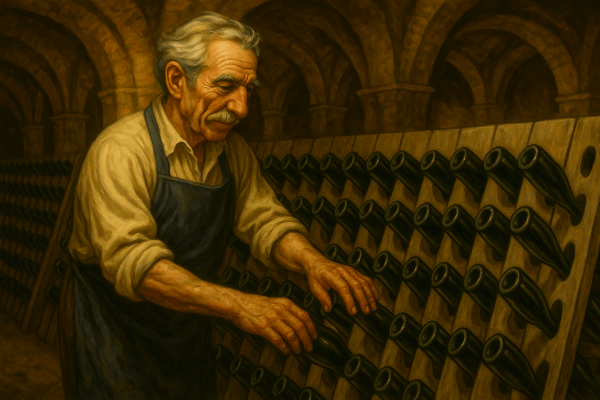
A master remueur might turn 40,000 bottles a day. But today, most Champagne houses use automated gyropalettes — rotating cages that mimic the old technique. Romantic? Perhaps not. Efficient? Certainly.
5. Dégorgement — The Grand Expulsion
Once the sediment has collected in the neck, the bottle is chilled so the top few centimetres freeze solid. When the crown cap is popped off, the internal pressure forces out the frozen plug of yeast — clean, swift, and a little explosive.
What remains is crystal-clear Champagne, vibrant and alive.
6. Dosage — The Final Touch
A small amount of wine mixed with sugar (liqueur d’expédition) is added to balance acidity and define the style —
from bone-dry Brut Nature to lusciously sweet Demi-Sec.
Finally, the bottle is sealed with the traditional mushroom-shaped cork and wire cage (muselet) — a familiar sight that has crowned celebrations for centuries.
Isabella
“It’s astonishing, really — every step is slow, manual, and exacting. Champagne isn’t just made; it’s composed.”
Koos
“And all of it, just to give us a few million tiny bubbles that make us smile. Worth every twist and pop, if you ask me.”
Champagne Glass Evolution
Few wines have inspired so many shapes of glass.
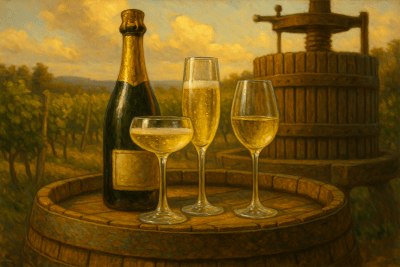
The Coupe — legend claims its shallow bowl was modeled on Marie Antoinette’s breast. Charming, but poor for bubbles.
The Flute — tall and slender; preserves bubbles beautifully but limits aroma.
Today: Wine Glasses — the modern movement favours wider bowls that allow the full fragrance to unfold.
Octavius
“I adore a flute for the visual poetry of rising bubbles — but for serious tasting, a white wine glass wins every time.”
From Champagne to the Cape – Birthplace of Cap Classique
The Early Sparkling Wines
South Africa’s great sparkling tradition began in 1971, when Simonsig produced the country’s first Methode Champenoise from Chenin Blanc.
But soon, politics and naming rights entered the picture.
The Crayfish Agreement
In the 1930s, South Africa and France struck a trade arrangement involving the export of Cape rock lobster (crayfish) in exchange for naming concessions.
As a result, South Africa eventually agreed not to use the word “Champagne” on labels.
Later, even the phrase Méthode Champenoise was barred.
So a new term was coined —
Méthode Cap Classique (MCC)
This proudly South African designation ensures the wine is made using the same bottle-ferment method as Champagne.
Isabella
“We lost the name, but we kept the craft — and the quality soared.”
Cap Classique Today
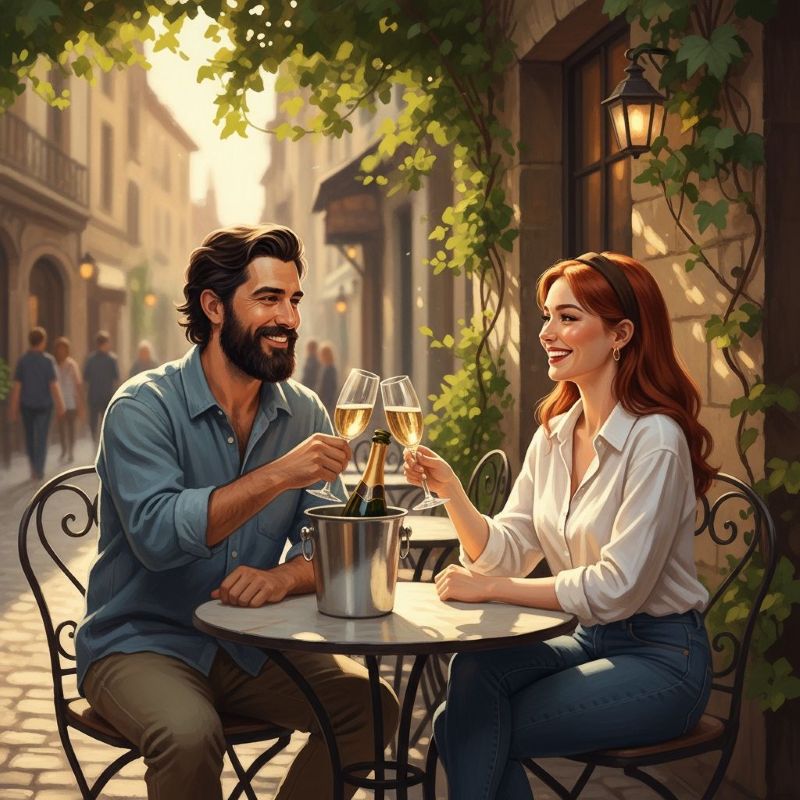
Cap Classique has flourished, embracing both French technique and local personality.
Expect:
- Citrus + green apple
- Pastry and brioche (from lees aging)
- Bright acidity
- Generous fruit
Some bottlings now spend 3–7+ years on lees, rivaling top Champagne.
Koos
“Just don’t mess it up with orange juice. If you want a mimosa, use something cheaper — tank-fermented fizz is made for that!”
Serving and Pairing
Soft cheeses
Ideal glass: white wine glass
Best temperature: 6–10°C
Food pairings:
Oysters, sushi
Fried chicken (trust us!)
Mushroom risotto
Champagne is no longer just a welcoming or celebratory drink it can be paired with many dishes or just drunk on its own.
Isabella
“Champagne with triple-cream brie may be the closest thing to edible enlightenment.”
Champagne or Cap Classique — Which Should You Choose?
Octavius
“Champagne is poetry with bubbles — centuries of knowledge, chalky soils, and cold northern sun.”
Koos:
“And Cap Classique gives you that sparkle without the aristocratic price tag. Proper craftsmanship. And sunshine.”
Isabella
“Let’s not choose — there’s room in the ice bucket for both.”
Interesting Fact — Champagne & Ship Launching
The tradition of breaking a bottle of Champagne over the bow of a ship before launching has uncertain origins, but it’s now part of maritime ceremony around the world. Traditionally, a woman performs the christening and sends the vessel on its way.
Pamela Vandyke Price recounts that, in its early days, the Champagne bottle was simply thrown — no ropes, no precautions. At one launch in Plymouth, a princess missed the ship entirely and instead struck a spectator on the head. The blow was serious enough that the injured guest claimed and received substantial compensation.
After that episode, the bottle was sensibly tethered to the vessel with a ribbon, preventing future mishaps — and sparing both spectators and Champagne.
Champagne / Cap Classique by Production Style
Non-Vintage (NV)
A blend of wines from multiple years designed to maintain a signature house style. Reliable, consistent, and the most common Champagne.
Vintage
Made from grapes harvested in a single year — only produced when the vintage is considered exceptional. Often richer and more structured, with longer ageing potential.
Prestige Cuvée / Tête de Cuvée
Top-tier bottling from a Champagne house. Think ultimate quality, long ageing, and premium pricing.Examples: Dom Pérignon, Cristal.
Blanc de Blancs
“White from white” — made only from Chardonnay. Elegant, crisp, citrus-driven; often more mineral and age-worthy.
Blanc de Noirs
“White from black” — made from Pinot Noir and/or Pinot Meunier. Fuller, richer, with red-fruit undertones.
Rosé Champagne
Made either by blending a little still red wine into the base blend, or less commonly by the saignée (bleeding) method. Expect strawberry, cherry, and spice.
Champagne/Cap Classique by Sweetness Levels
Brut Nature / Pas Dosé / Zero Dosage
0–3 g/L sugar
Bone-dry, electric, laser-focused. No sweetness added.
Extra Brut
0–6 g/L sugar
Very dry, but slightly more forgiving than Brut Nature.
Brut
0–12 g/L sugar
The most common style — dry but balanced. Great all-purpose Champagne.
Extra Dry / Extra Sec
12–17 g/L sugar
Confusingly not as dry as Brut. Off-dry, rounder.
Sec
17–32 g/L sugar
Noticeably sweeter; fruit-forward. Great with light desserts.
Demi-Sec
32–50 g/L sugar
Definitely sweet — dessert Champagne territory
Key Takeaways
Champagne = protected region in France
Cap Classique or MCC = same method, South African expression
Both undergo second fermentation in bottle
Riddling & disgorging are central to clarity + finesse
South African Cap Classique offers exceptional value and the quality has improved dramatically over the years.
 About Uncorked and Curious
Leave a comment