A ferment-fueled exchange between Koos Grenache and Professor Octavius Pinot

Octavius Pinot
“Let’s begin with the basics: fermentation is nature’s alchemy — yeast feeds on grape sugars and gives us alcohol, aroma, heat, and a touch of mischief.”
In red winemaking, that transformation happens right on the crushed skins — where colour, tannin, and depth are coaxed from the cap floating on top.
Koos
“Couldn’t put it better, Prof. It’s where the juice finds its voice. That wild moment when vineyard and cellar collide — no recipe, just transformation.”
Octavius
“Of course, not all ferments are left to chance. Stainless steel offers precise control. Concrete brings texture. And fermentation temperature? That’s critical — too warm and you blow off the aromatics, too cold and the ferment stalls.”
Koos
“That’s why I love concrete. It’s like a stone blanket — keeps things steady without fuss. No fancy cooling jackets needed, just instinct and a decent thermometer.”
Octavius
“And the yeast — that invisible conductor of it all. Do you ever consider commercial strains?”
Koos
“Sure, I’ve considered them — then I tossed the packet. We trust the vineyard, the skins, even the dusty cellar walls. That wild yeast brings character you can’t bottle from a lab.”
Octavius
“But not all commercial strains are sterile villains. Some are designed to mimic native ferments — to highlight a region’s fruit or preserve aromatics without the risks.”
Koos
“Fair enough. I guess it’s not always a battle between art and science. Some folks use cultured yeast to guide the ferment, not dominate it. That’s fine — as long as they don’t forget where the flavour starts.”
Octavius
“Indeed. And speaking of flavour, we’d be remiss not to mention the physical side of fermentation — cap management.”
Koos
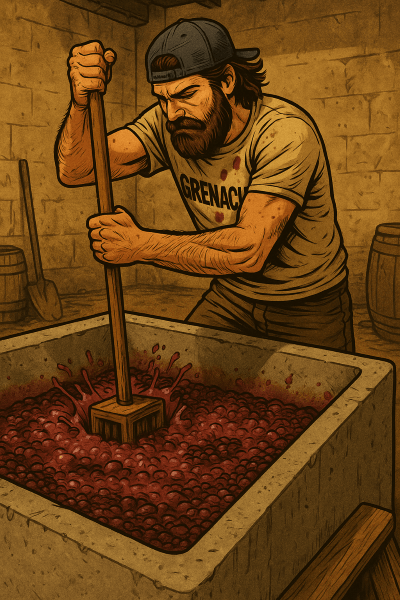
“Now you’re talking. Punching down the cap, pumping over — that’s where you really get your hands dirty. It’s not just about sugar and yeast — it’s about colour, tannin, and mouthfeel. That cap of skins and pips floats to the top and if you don’t work it, you lose the soul of the wine.”
Octavius
“Exactly. With red wines, extraction is everything. That deep ruby colour, those supple tannins — they’re coaxed out with every gentle punch or pump. It’s the tactile magic of winemaking.”
Koos
“Magic, sweat, and a lot of stained shirts. But it’s worth it. You can smell when the cap’s happy.”
Octavius
“And once primary fermentation wraps up and the wine is racked into barrel, we enter another quiet transformation — malolactic fermentation.”
Koos
“Ah, the mellowing magic. Malo takes that sharp malic acid — the green apple stuff — and smooths it into soft lactic acid. It’s like the wine takes a deep breath and settles in.”
Octavius
“Especially in reds — it’s almost universal. But in whites, particularly Chardonnay, it’s a stylistic choice. Some go full malo for richness and creaminess; others minimize it to keep things crisp.”
Koos
“Either way, it’s still fermentation — just a bacterial one instead of yeast. Still part of the dance.”
Octavius
“Then here’s to the dance — from wild yeast to cultured strains, cap management to malo — all serving the grape.”
Koos
“And to letting the juice decide.”
So… What Did We Learn?
Fermentation transforms grape sugar into alcohol, aroma, and texture.
Yeast can be wild (native) or cultured (commercial).
Fermenter types: stainless steel for control, concrete for texture and heat retention.
Temperature influences aromatic retention and fermentation success.
Cap management (punchdowns and pumpovers) is key in red wine for colour, tannin, and flavour.
Malolactic fermentation is a secondary process that softens acidity — common in reds, optional in whites like Chardonnay.

 About Uncorked and Curious
Leave a comment